
As Bangladesh moves to strengthen tourism infrastructure in Cox’s Bazar, the proposal to establish dedicated beach health centres has emerged as a timely and necessary initiative for the world’s longest unbroken natural sea beach.
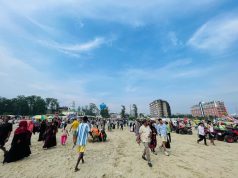
Every year, millions of tourists visit Cox’s Bazar for recreation, sea bathing, water sports, and holidays, especially during Eid-ul-Fitr and Eid-ul-Azha, Puja, other religious and governmental holidays, and the peak tourism season, winter.
However, despite the growing tourism economy, the beach still lacks a comprehensive emergency healthcare system capable of responding quickly to drowning incidents, heatstroke, injuries, infections, and climate-related emergencies.
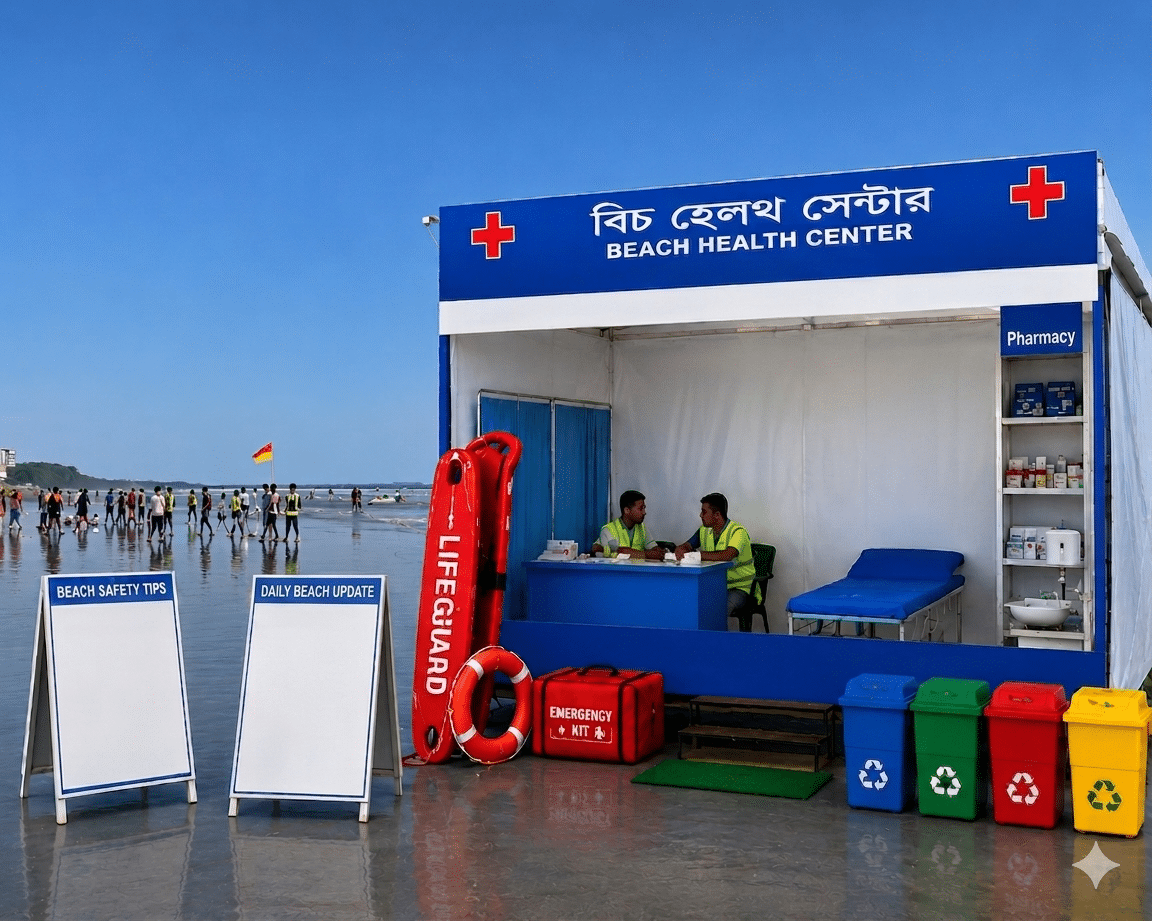
Recently, the government announced plans to establish beach health centres in Cox’s Bazar and Patuakhali to improve tourist safety and emergency medical response at coastal destinations.
Civil Aviation and Tourism Minister Afroza Khanam said that revising existing safety policies was essential to ensuring tourist security and asked the deputy commissioners of Cox’s Bazar and Patuakhali to submit project proposals to the ministry at the earliest opportunity.
Stakeholders said that the initiative could play a major role in modernising beach safety management in Bangladesh.
Global experience shows that beach destinations with robust emergency healthcare systems are considered safer and more sustainable for tourism.
Thailand’s Phuket, one of Asia’s busiest beach destinations, operates an integrated safety network combining lifeguard towers, first-aid stations, and coordinated ambulance and emergency medical services.
Similarly, Australia’s famous Bondi Beach maintains permanent lifeguard patrols, surf rescue systems, and rapid emergency response services through the Bondi Surf Bathers’ Life Saving Club.
Popular tourist destinations such as Goa, Bali, and Sentosa also maintain beachside medical support systems and tourist clinics to handle drowning cases, dehydration, surfing injuries, and other tourist-related emergencies.
Experts said that Cox’s Bazar could significantly benefit from adopting similar models to address emergencies such as drowning, heatstroke, dehydration, water-sport injuries, food poisoning, infections, and disaster-related incidents, including cyclones and storms.
According to the World Health Organization, drowning remains a major global public health issue, particularly in low- and middle-income countries. Coastal tourist zones with large crowds require rapid emergency response systems to reduce fatalities and injuries.
In Cox’s Bazar, sea safety concerns are not new.
Since 2012, the Sea Safe programme, jointly operated by the Centre for Injury Prevention and Research, Bangladesh, and the Royal National Lifeboat Institution, has been providing lifeguard services at selected beach points due to recurring drowning incidents.
Speaking to Cox’s Bazar Life, Sea Safe Lifeguard field team manager Imtiaj Ahmed said that establishing beach health centres would be a highly positive step and a long-standing demand raised during discussions with stakeholders.
“We have rescued 1,008 tourists from drowning over the past 12 years. Along the beach, there are always risks of drowning as well as other medical emergencies,” he said.
He noted that in many cases, seriously ill tourists have to be transported at least three kilometres for treatment, while ambulances are not always readily available.
“Sometimes patients collapse before reaching medical facilities. If there were health centres along the beach with adequate ambulance support, many more patients could possibly be stabilised and saved,” he added.
At present, one ambulance operated by the Beach Management Committee remains stationed at Laboni Point.
However, Imtiaj said that at least three major tourist points — Laboni, Kolatoli, and Sugandha — require adequate ambulance support to provide emergency services for the huge number of tourists, along with health centres.
Public health concerns also extend beyond drowning incidents.
Research published in the Journal of the Sylhet Agricultural University found microbial contamination and pollution in coastal waters in Cox’s Bazar due to waste discharge and drainage systems.
Experts warned that contaminated seawater could increase the risk of skin diseases, stomach illnesses, and infections among beachgoers, making nearby medical facilities increasingly important.
Climate vulnerability adds another layer of concern.
Cox’s Bazar is one of Bangladesh’s coastal regions, highly exposed to storm surges, flooding, erosion, and extreme weather events. Every year, tourists fall victim to weather-related emergencies and accidents.
During such incidents, immediate access to medical support becomes critical for both tourists and local residents.
Tareque Mohammad Mortaza Hasan, a tourism enthusiast, said that modern beach management was no longer limited to beautification projects and hotel development alone.
“Safety infrastructure, including lifeguard systems, emergency rescue services and beach health centres, is now considered an essential component of sustainable tourism,” he added.
Stakeholders said that establishing dedicated beach health centres in Cox’s Bazar could significantly improve emergency preparedness while strengthening the beach’s image as a safer and more internationally competitive tourist destination.
By Saddam Hossain
AI Generated Photo