
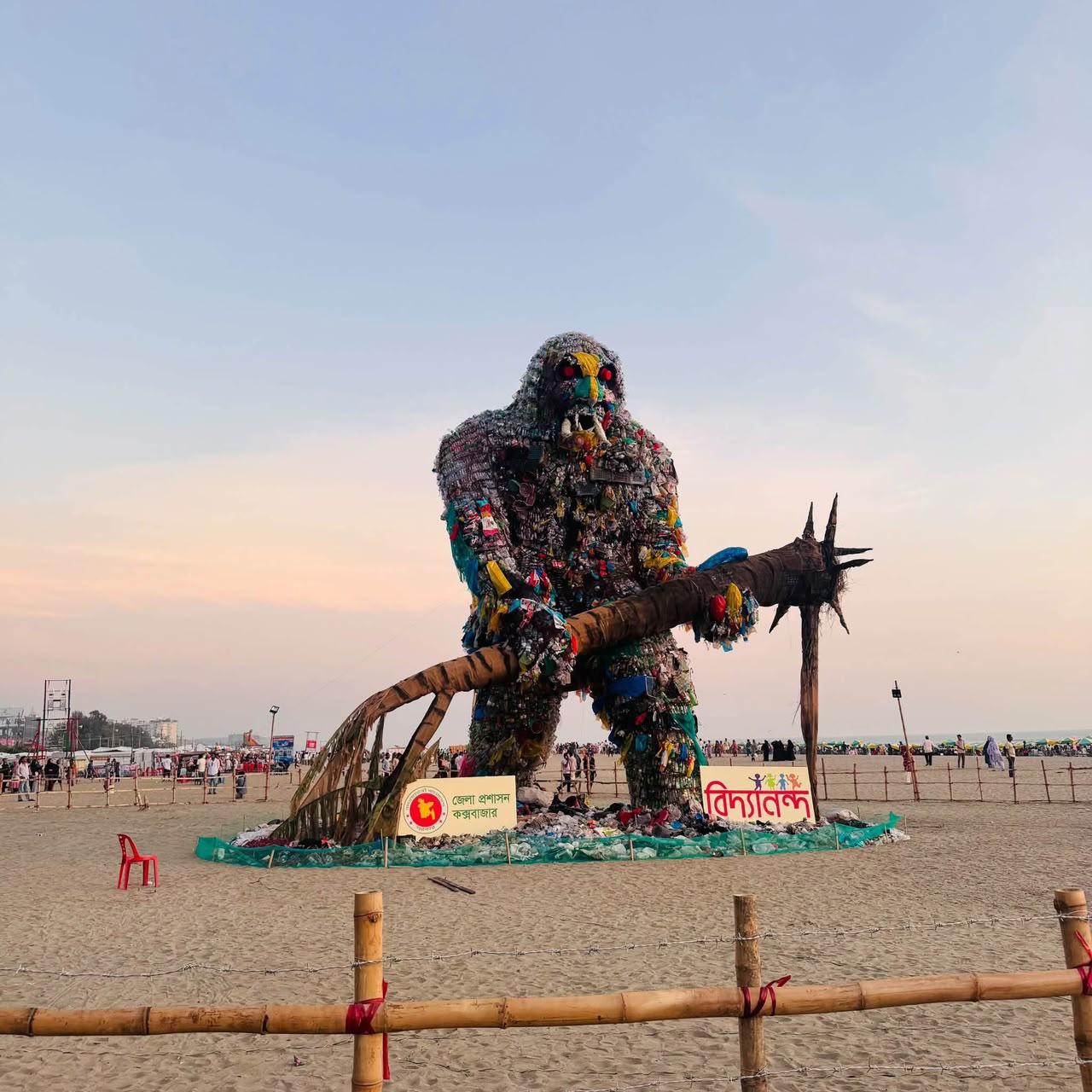
A 50-foot plastic monster has risen from the sandy shore of Cox’s Bazar, holding an uprooted coconut tree in its hand and covered in people’s discarded plastic waste. From a distance, it looks like a terrifying creature emerging from the sea’s depths. Up close, however, it becomes clear that the monster is not from a fairy tale but a symbol of human carelessness and the dangers of plastic pollution.
Cox’s Bazar deputy commissioner MA Mannan unveiled the sculpture, made from plastic waste, for public display on the beach between Sugandha and Sea-Gull points on Monday evening, October 12.
The four-month exhibition has been organised by Bidyanondo Foundation with support from the district administration. The organisers aim to highlight the harmful effects of marine pollution on hundreds of thousands of tourists and local people and encourage responsible behaviour in managing plastic waste.
Police superintendent Sajedur Rahman, additional district magistrate Tasnim Jahan, additional deputy commissioner (general) Md Shahidul Alam and other officials attended the inauguration.
The organisers said the 50-foot sculpture was made using five tonnes of plastic waste collected from the sea and surrounding areas. Artists from the Faculty of Fine Arts at Dhaka University spent 20 consecutive days building it with plastic collected from Inani, Teknaf and Saint Martin’s beaches.
Alongside the sculpture, the organisers set up a special theatre on the beach to screen awareness films on responsible tourism. Visitors must bring two discarded plastic bottles as an entry fee to watch the films. Through this initiative, the organisers want to highlight the importance of collecting and recycling plastic waste alongside providing entertainment.
Speaking at the inauguration, Deputy Commissioner MA Mannan said the sea was an important part of the country’s natural resources, biodiversity and economy. However, plastic waste has long threatened marine and beach environments due to a lack of awareness.
Such an innovative initiative would make pollution’s severity visible to the public and encourage behaviour change, he said.
He called on tourists, local residents, businesses and all relevant stakeholders to work alongside the administration to keep Cox’s Bazar clean.
Bidyanondo Foundation director Jamal Uddin said people often enjoyed the sea’s beauty but forgot their role in polluting it.
He said the monster made from discarded plastic reflected people’s lack of awareness. The organisers hoped visitors would do more than take photographs of the sculpture and leave; they wanted people to question where they discarded their plastic waste and how it harmed the sea.
Local visitor Sadia Sumaiya said the sculpture showed how readily available plastic products had harmed the environment over several decades.
Similar monsters had been built at the site over the past few years, she said, adding that it remained unclear whether people became more aware after taking and sharing photos on social media.
The initiative would be successful if people remembered the sculpture before littering the beach, she added.
Tourist Rabi Alam, who came from Noakhali, said many visitors littered the beach with chip packets, water bottles and other waste. He said the monster was built from the same plastic people discarded, showing the severe consequences of careless behaviour.
Helal Uddin, a tourist from Savar, said people were polluting a naturally beautiful place by dumping plastic and other waste. The sculpture’s main message was that plastic and other rubbish should be disposed of at designated places rather than thrown indiscriminately, he said.
Physician Abid Azad, who came from Dhaka, said preventing plastic pollution required effective administrative measures as well as individual awareness. He said tourist destinations needed enough dustbins, more awareness programmes, and proper law enforcement.
Plastic pollution could not be controlled through government initiatives alone; the government and the public had to work together, he added.
Bidyanondo Foundation volunteer Muhammad Mubarak said the 50-foot monster was built from five tonnes of plastic. Its depiction of an uprooted tree symbolised how plastic pollution threatened the environment and oxygen sources.
He said the sculpture aimed to make the environmental damage happening silently visible.
Bidyanondo Foundation said it had been conducting plastic awareness activities in Cox’s Bazar and Saint Martin’s since 2022. Its Plastic Exchange Store in Cox’s Bazar operates year-round, allowing people to exchange discarded plastic for essential goods. Some of the plastic collected through the initiative was used to build the sculpture.
Additional District Magistrate Tasnim Jahan said the administration was continuing its symbolic campaign against environmental pollution and awareness activities with the support of Bidyanondo Foundation, following similar initiatives in previous years.
The organisers said they used different symbolic sculptures each year to show how people’s discarded plastic threatened the environment, biodiversity, and the future. Raising environmental awareness among children was also a key objective.
The 50-foot plastic monster on the beach is therefore more than an artwork; it symbolises the consequences of human waste.
Additional Deputy Commissioner (General) Md Shahidul Alam expressed hope that the initiative would achieve its purpose if the sculpture encouraged people to use plastic more responsibly and dispose of waste in designated places.
Cox’s Bazar Life Report
Photo: Abdu Rashid Manik