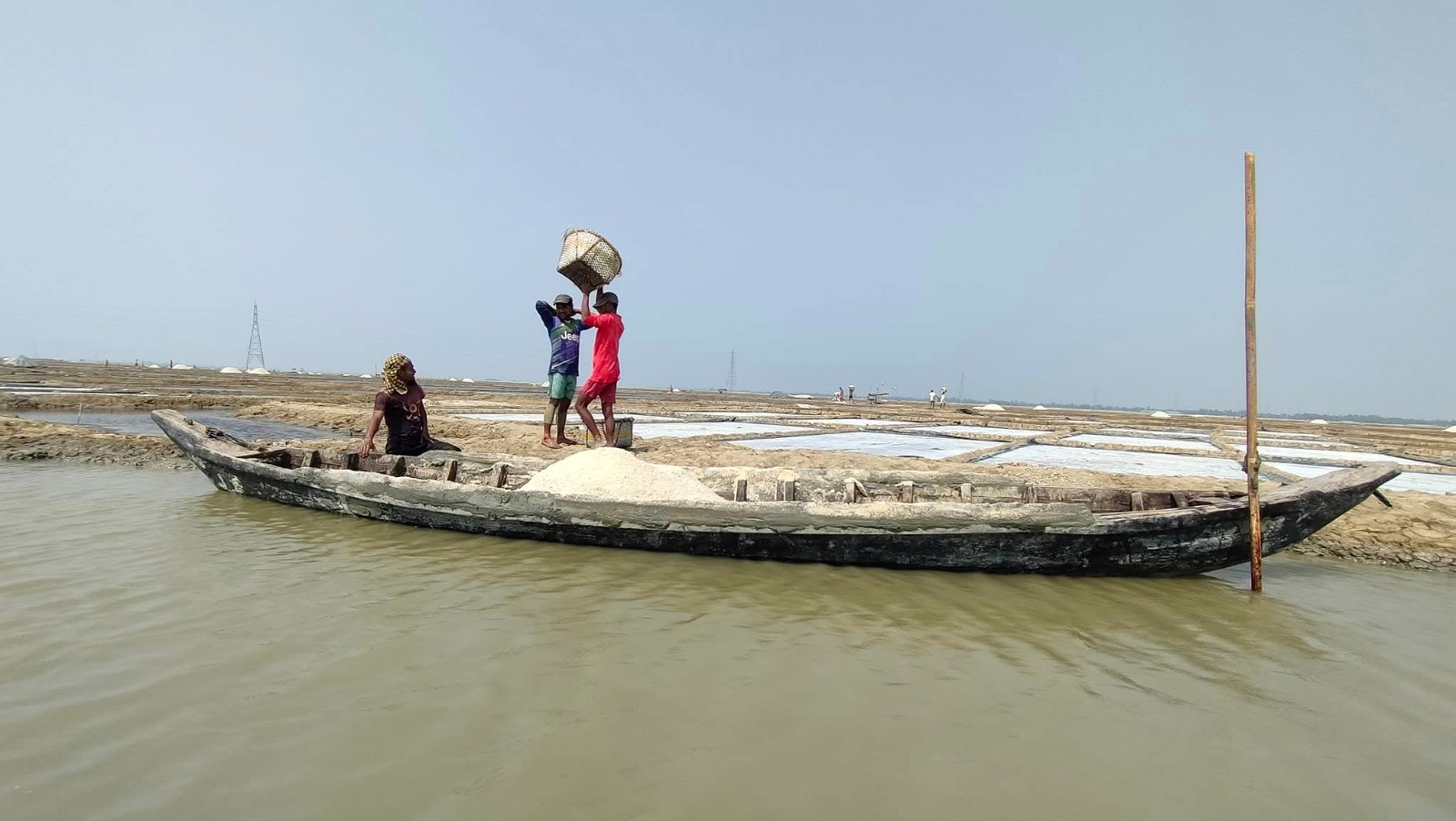
Salt farmers in Cox’s Bazar worry about getting fair prices for their produce as the government moves to allow the import of 150,000 tonnes of crude salt, despite an estimated 500,000 tonnes remaining stockpiled in fields.
Farmers and traders fear imported salt could put downward pressure on local prices, leaving farmers struggling to recover production costs and discouraging them from cultivating salt next season.
Nur Mohammad, a salt farmer from Hazariapara in Kutubdia’s Lemshikhali, cultivated salt on 240 decimals of land during the last season, spending around Tk600,000. Despite adverse weather, he produced around 1,400 maunds of salt.
He sold 600 maunds at the beginning of the season when prices were low and stored the remaining 800 maunds in pits, hoping to sell them later when prices increased.
He is now worried about the value of his stock after the government moved to allow the import of crude salt.
Speaking over the phone on Sunday afternoon, Nur Mohammad said he spent Tk40,000 per 40 decimals of land for leasing, Tk6,000 on polythene and around Tk170,000 on labour.
The price of salt was Tk200–220 per maund at the beginning of the season and later rose to around Tk400. It is currently being sold at Tk380–390 per maund, but farmers receive around Tk320 after middlemen deduct about Tk60 in various costs, he said.
“I take loans and borrow money every year to cultivate salt, but we do not get a fair price for our produce. The cost of everything has increased. If salt is imported from abroad, farmers will suffer severely,” Nur Mohammad said.
Abdur Rahim, a salt trader from Lemshikhali, said importing salt despite sufficient stocks in the fields would hit marginal farmers hardest.
He called for a high-level investigation to determine the actual amount of salt currently stored in the fields before any import decision is implemented.
Farmers, traders, and others involved in the salt industry share these concerns, fearing that several hundred thousand people dependent on the sector in Cox’s Bazar could be affected.
According to leaders of the Cox’s Bazar Salt Farmers’ Association, around 42,000 farmers were involved in salt production in the district during the last season. Cox’s Bazar accounts for around 87 per cent of the country’s total salt production.
A total of 68,505 acres of land in Cox’s Bazar and Bashkhali of Chattogram were used for salt cultivation during the last season, they said.
500,000 tonnes of salt stockpiled in fields
The Bangladesh Small and Cottage Industries Corporation (BSCIC) reports that fields currently hold approximately 500,000 tonnes of salt.
The country requires around 200,000 tonnes of salt a month. Meanwhile, salt produced in the new season is expected to enter the market by December.
BSCIC data show that total demand for refined salt in the 2026–27 fiscal year is estimated at 2.1 million tonnes. Of this, 750,000 tonnes are expected to be used as edible salt, 950,000 tonnes for industrial purposes, 37,000 tonnes for fish farming and 306,000 tonnes for the livestock sector.
On September 23, the Office of the Chief Controller of Imports and Exports under the Ministry of Commerce began the process of allowing the import of 150,000 tonnes of crude boulder salt.
Following a recommendation from the Ministry of Industries, the import has been recommended for BSCIC-registered and operational salt mills.
Around 251 mills have been asked to submit applications with the necessary documents by October 1.
Under the proposed allocation, 244 mills would be allowed to import 543 tonnes each, totalling 132,500 tonnes. In comparison, seven mills producing salt through the vacuum method would receive allocations of 2,500 tonnes each, totaling 17,500 tonnes.
However, according to people involved in the sector, 86 of the 244 mills did not produce any edible salt between July last year and August this year.
Farmers, traders fear pressure on prices
Salt farmers and traders in Cox’s Bazar said a large portion of the salt currently available in the fields is still stored in pits by farmers. Many have been unable to market their produce because of adverse weather.
They fear that imports at this stage could put additional pressure on the local salt market.
Abdur Rahim, the Lemshikhali salt trader, reiterated that sufficient salt is currently stored in the fields and said there was no immediate need to import salt.
“If necessary, the amount of salt stored in the fields can be verified through a high-level investigation before a decision on imports is made,” he said.
Saifuddin, a salt trader from Gomatali in Eidgaon, said a farmer generally cultivates salt on at least three kani of land, requiring around Tk300,000 in production costs.
Under normal weather conditions, around 600 maunds of salt can be produced from that amount of land. At current prices, however, the profit after recovering production costs remains limited, he said.
If the import permission remains in place, marginal farmers may lose interest in cultivating salt next season, Saifuddin said.
Manjur Alam, general secretary of the Islampur Salt Mill Owners’ Association in Eidgaon, said salt from the new season would begin reaching the market by December.
It would take time to import salt from abroad and bring it to the local market, he said, adding that the authorities should first assess whether current stocks are sufficient to meet demand.
Mizanur Rahman Chowdhury Khokon Mia, general secretary of the Cox’s Bazar Salt Farmers and Traders Association, said sufficient salt was still stored in the fields.
“Farmers have been unable to sell much of their produce because of adverse weather. Much of this stock will begin entering the market towards the end of this month,” he said.
If imported salt enters the market at the same time, local prices could fall, and farmers could lose the opportunity to receive fair prices for their produce, he said.
BSCIC explains reason for proposed imports
BSCIC officials said salt production was somewhat lower last season because of adverse weather conditions.
According to them, existing stocks may last until around mid-December. Although salt from the new season is expected to reach the market before stocks run out, production was very low during the first two months of last season.
Based on that experience, they said the import recommendation was made to address a possible shortage lasting around 20 to 25 days.
However, Md Zafar Iqbal Bhuiyan, deputy general manager of the Cox’s Bazar Salt Industry Development Office, said the latest update showed that around 500,000 tonnes of salt remained stockpiled in the fields.
The country requires around 200,000 tonnes of salt a month, meaning the current stock could meet demand for around two and a half months, he said.
Regarding the import approval, Bhuiyan said, “I have not received any documents about the approval for the import.”
He said the previous season had been difficult for farmers because of adverse weather and that farmers would begin preparing their fields for the next season towards the end of October.
By Tarekur Rahman
Photo: Tarekur Rahman