
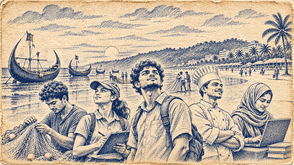
Today, November 1, marks National Youth Day. Young people are not merely a demographic group; they are a driving force behind economic growth. According to the 2022 census, Cox’s Bazar has a population of 2,823,268. An estimated 910,000 residents, or more than 32 percent, are aged between 15 and 39. Their employment and productivity will largely shape the district’s economic future.
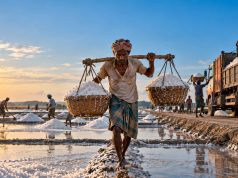
Tourism, hospitality, marine fisheries, dried fish processing, salt production and development organizations provide major employment opportunities for local youth. Large-scale projects in Maheshkhali and Matarbari offer further prospects. Yet how much of this investment translates into stable jobs for local people? Why do young workers in a district rich in tourism and marine resources remain dependent on seasonal earnings?
Research by the International Labour Organization (ILO) indicates that nearly 59 percent of employed people in Cox’s Bazar are underemployed. Another 41.5 percent of young people are reportedly not in education, employment or training. Conventional unemployment figures therefore fail to capture the full crisis. Many work without earning enough, while others face declining incomes after the five-to-six-month peak tourism season.
The solutions lie partly within the local economy. Tourism must become a year-round industry, supported by internationally recognized hospitality training, language education, digital skills and modern fisheries technology. Major development projects should create more opportunities for qualified local workers. Accessible business loans, entrepreneurial support and regular job fairs are equally important.
The blue economy offers particularly promising opportunities. Modern fish preservation, environmentally responsible dried fish production, seaweed cultivation, cold-chain logistics, marine product processing and ecotourism could generate sustainable livelihoods. Young people must also develop practical skills in technology, foreign languages, digital marketing and entrepreneurship rather than relying solely on conventional qualifications.
Employment policies must reflect Cox’s Bazar’s particular circumstances: pressures associated with the Rohingya refugee presence, climate risks, migration, limited female labor-force participation and economic differences between upazilas. A phased approach should prioritize language and digital training immediately, fisheries processing and blue-economy enterprises in the medium term, and technical education and investment support over the longer term.
The economic implications are substantial. Based on population and labor-market indicators, we believe that enabling 300,000 young people to secure new or more productive employment, increasing their monthly earnings by an average of Tk 12,500, could generate approximately Tk 4,500 crore in additional annual income for the local economy.
Creating stable, productive employment for those among Cox’s Bazar’s 900,000 young people facing unemployment, underemployment and seasonal uncertainty would inject fresh momentum into the district’s economy. Turning this immense potential into reality should be a central priority on National Youth Day.
By Salam Abu
Editor