
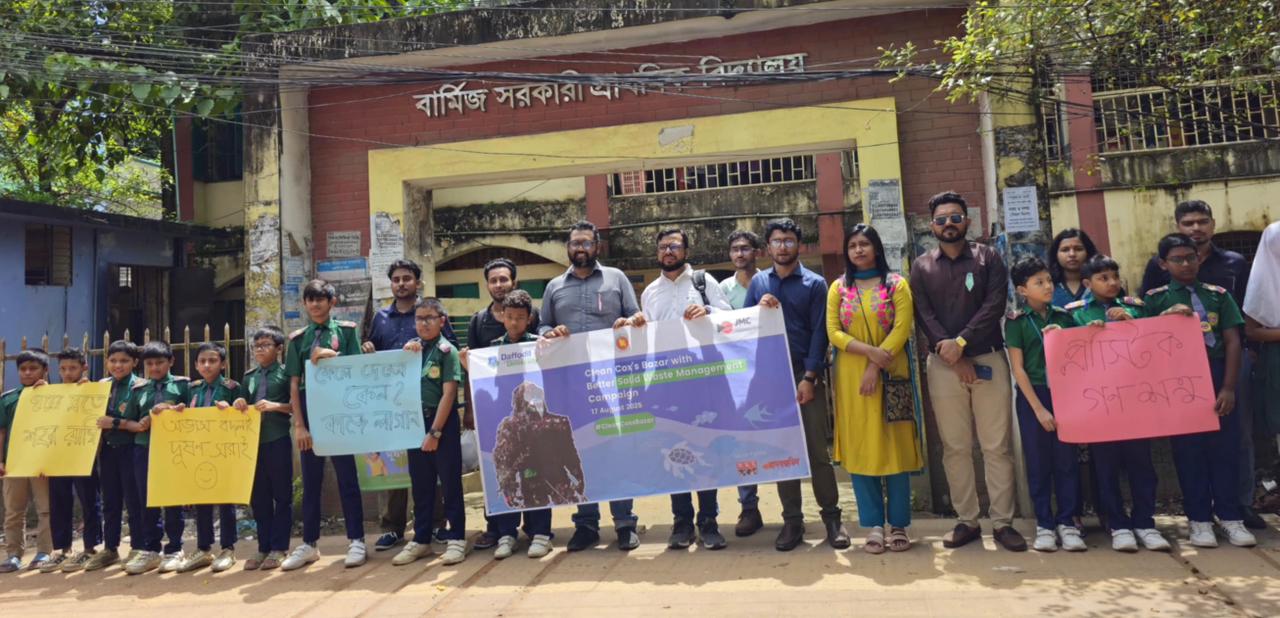
Raising awareness about the dangers of plastic pollution, postgraduate students from the Department of Journalism, Media, and Communication at Daffodil International University engaged with students of Burmese Government Primary School and Municipal Preparatory High School in Cox’s Bazar on Sunday.
The initiative included discussions on the harmful effects of plastic products, followed by a silent awareness campaign on the streets where students held placards and pledged to “Refuse Polythene.”
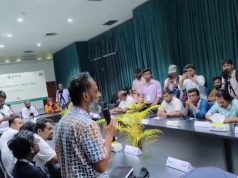
Later that day, a roundtable discussion was held at the auditorium of the Department of Public Health Engineering (DPHE), where officials and experts emphasized that strengthening public awareness was crucial, as stricter enforcement of laws alone would yield little success.
Ibn Mayaz Pramanik, Executive Engineer of the DPHE, argued that Bangladesh’s widespread health problems—such as dengue, colds, and fevers—are linked to unhygienic lifestyles.
He emphasized the importance of recycling plastic products while also advocating for an outright ban on polythene use. Similarly, the district’s primary education officer called for policy-level decisions across all government departments to stop plastic use.
Mahfuzur Rahman, Project Director of BRAC, highlighted inefficiencies in waste management. “Even when households separate biodegradable and non-biodegradable waste, the city corporation often mixes it all during collection. As a result, plastic waste continues to not only cause public suffering but also harm marine resources. Fish stocks in the sea are already declining,” he said.
Mahbubur Rahman, Development Officer of the NGO DSK, contended that unless we reduce plastic production at its source, we cannot control its use. UNDP’s Project Development Specialist, Dipak K.C., echoed the call, urging a halt to production and promoting sustainable alternatives to plastic and polythene.
However, local journalists and environmental activists criticized government agencies and NGOs, claiming that most of their initiatives to curb plastic and polythene use are “mere eyewash” rather than real solutions.
Dr. Aftab Hossain, Head of the Department of Journalism, Media, and Communication at Daffodil International University, and Associate Professor Dr. Abdul Kabil Khan, also attended the roundtable.
By Mohammad Morshed
Photo: Courtesy