
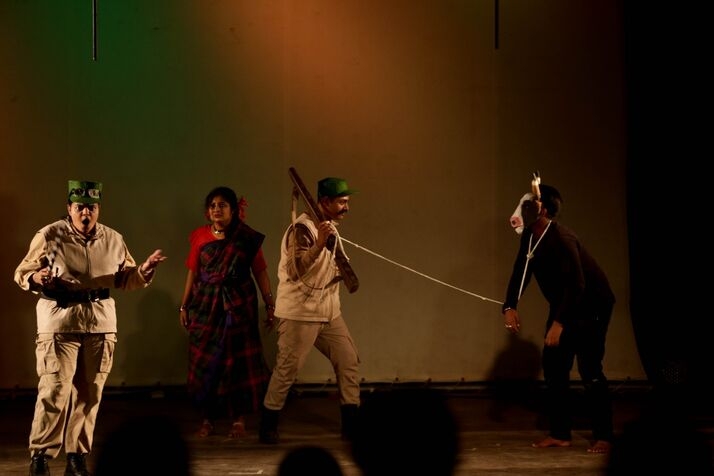
Invisible walls of law, restrictions, and power stand on one side; hunger, songs, and an unyielding will to survive stand on the other. This silent yet relentless human struggle over land was poetically brought to the stage through the play Bhumisutra.
The play was staged on Saturday evening at Shaheed Subhash Hall of Cox’s Bazar Public Library. It marked the concluding production of a four-month, production-based theatre workshop organized by the Cox’s Bazar District Committee of Bangladesh Udichi Shilpi Goshthi.
Performed by nearly fifty trainees, Bhumisutra was written and directed by Imran Hossain Imu, with music direction by Ridita Mayisha.
Director Imran Hossain Imu said the play is not merely about a land crisis. “Bhumisutra reflects human roots, pride, greed, and the tension between dreams and survival. In this play, the soil itself speaks—it carries within it the history of exploitation, resistance, and helplessness.”
He added that every character represents real people. At the same time, the chorus is portrayed as the “soul of the soil,” serving as witnesses to events, custodians of history, and a warning for the future. “Land is not just a resource; it is memory, relationships, existence, and conscience. From this realization, Bhumisutra emerges as a poetic yet harsh story of a village, its people, and their inseparable bond with the soil,” he said.
Udichi Cox’s Bazar District President Ashutosh Rudra described the production as part of the organization’s long-term commitment to theatre practice. “Through this workshop, we tried to connect the new generation with the language of the stage and a sense of responsibility,” he said.
General Secretary Saurav Dev noted that Udichi has always spoken for the people. “Bhumisutra is an artistic continuation of that tradition of protest,” he added.
Bhumisutra is a political and humanistic play where land is portrayed not merely as property but as a source of power. As rural farmers seek to access their livelihoods, they are hindered by laws, restrictions, and unjust structures. Gradually, empathy erodes, and silent anger accumulates.
The central character, Arup Kabiyal, is a folk singer who earns his living through traditional songs. Trapped in long-standing land grabbing and cycles of power, his family and community slowly become suffocated. At the same time, the media conceals reality and constructs narratives of “development,” pushing the voices of truth further into darkness.
Through themes of land ownership, human rights, distorted truth, moral decay, and subtle resistance, Bhumisutra unfolds as a poetic protest.
The audience response was visibly emotional and appreciative. In the tourist city of Cox’s Bazar, a positive trend of audience members purchasing tickets to watch stage plays was also evident. Many viewers expressed satisfaction, saying it had been a long time since they had seen such a thoughtful and socially responsible theatre production in the city.
Audience member Mostafizur Rahman said the play encourages reflection beyond entertainment and helps people understand society, adding that regular stage productions are essential for Cox’s Bazar.
Nasrin Akhter remarked that the story felt deeply familiar, capturing the relationship between land, people, and power with striking closeness. Another viewer, Shafiqul Islam, said the play lingered in his mind long after it ended, calling it the true strength of good theatre.
Rubel Chowdhury expressed hope that Udichi would continue staging plays that speak for the marginalized. “Theatre should give voice to those who cannot speak,” he said.
Cultural organizer Ashraful Huda Siddiqui Jamshed noted that the enthusiastic audience response clearly showed that Bhumisutra is not just a theatre production by Udichi, but a strong signal of the revival of stage culture in Cox’s Bazar.
By Abdu Rashid Manik
Photo: Hussain Shetu