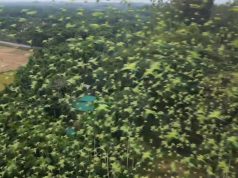

Nature appears to be unveiling a renewed charm at Himchari along Cox’s Bazar’s Marine Drive.
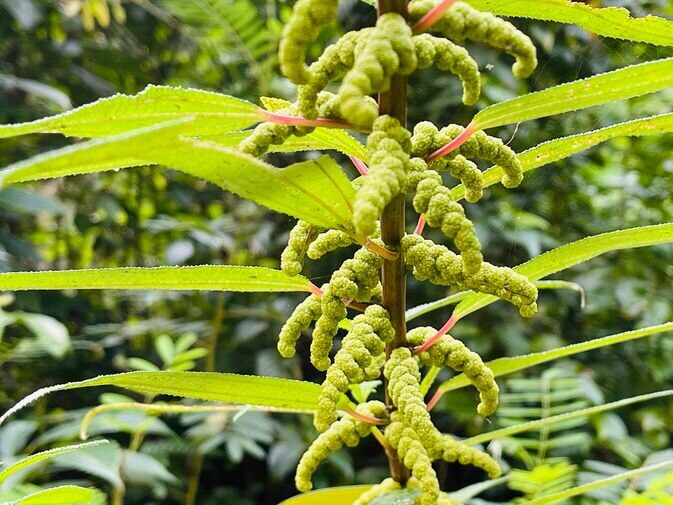
Deep inside the lush green hill forest, visitors are noticing a distinctive wild plant with clusters of green flowers or buds hanging from its branches—an unusual sight that has drawn the attention of nature lovers.
Thriving in its natural habitat, the plant has added a new dimension to Himchhari’s rich biodiversity.
The plant, locally known as Nate Shak, grows naturally in the Himchhari area.
Its scientific name is Amaranthus, a genus of wild plants. One of its defining features is the green, clustered flowers and fruits that grow from the stems and leaf axils.
On-site observation shows slender, elongated leaves interspersed with bunches of green, flower- or fruit-like clusters wrapping around the branches.
Environmental enthusiasts believe the humid conditions and natural shade of the hilly forest make Himchhari an ideal environment for this plant to flourish organically.
Abdullah, a local environmentally conscious youth from Himchhari, said that a wide variety of wild plants are usually seen in the area during the transition between the monsoon and winter remains.
“Although tourist footfall has increased recently, much of Himchhari’s natural beauty still remains intact, which is playing a positive role in conserving biodiversity,” he added.
Environmentalists say such plants do more than enhance the visual appeal of forested areas like Himchhari.
They also serve as important sources of food and shelter for birds, insects, and other wildlife.
As a result, they stress the need for stronger conservation efforts to protect the natural forests surrounding the Marine Drive.
The quiet message of nature here is clear: without balancing tourism development with environmental and biodiversity conservation, the serene beauty of Himchari may one day fade away.
By Mohammad Morshed
Photo: Mohammad Morshed