

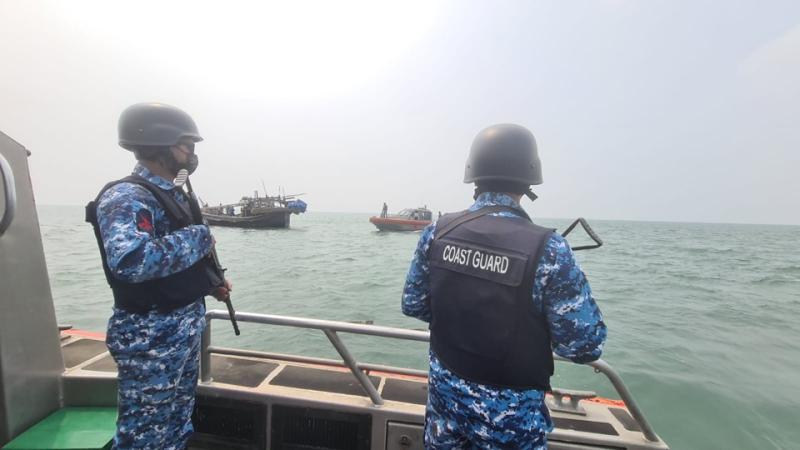
The Bangladesh Coast Guard has stepped up operations to prevent the illegal smuggling of fuel to Myanmar through sea routes. Patrols have been intensified from the Naf River to the deep sea and along the coastal belt, with increased manpower and enhanced surveillance using modern technology. The authorities have also intensified intelligence activities to combat piracy in the region.
Amid the ongoing war situation in the Middle East, global fuel prices have become volatile. In this context, the government has issued directives to ensure the proper management and economic use of the country’s fuel reserves. To prevent any attempts to smuggle fuel by sea, law enforcement agencies have adopted a strict stance.
Regular patrols involving multiple vessels are underway in the waters of the Naf River along the Bangladesh–Myanmar border. Authorities have also deployed additional personnel to prevent fuel smuggling, as well as other crimes such as contraband trade, drug trafficking, human trafficking, and piracy.
Beyond the Naf River, the Coast Guard has tightened monitoring from the deep sea to the coastal areas. Authorities closely monitor all types of vessels operating at sea, and any suspicious movement triggers immediate interception and search operations. Fishermen have expressed relief over the heightened vigilance.
Rashid Ahmed, a fisherman from the trawler FB Mayer Doa, said it was important to ensure that the country’s fuel remains within Bangladesh and is not smuggled to Myanmar. He described the Coast Guard’s ongoing drives against fuel smuggling as a positive initiative.
Ibrahim, another fisherman from the same trawler, emphasized that the country’s resources should not be smuggled abroad under any circumstances. He also urged authorities to ensure that the current fuel situation does not adversely affect fishermen and their livelihoods.
Recently, pirate groups have become increasingly active in the Bay of Bengal, particularly along the coasts of Cox’s Bazar, Maheshkhali, Sonadia Island, Kutubdia, and Banshkhali. Pirates frequently target fishing trawlers, according to fishermen.
Fisherman Robiul Alam of the trawler FB Ishfa said that fishermen now feel increasingly unsafe when heading into the deep sea to fish as piracy has intensified, posing serious security threats to those working at sea.
Another fisherman from the same trawler, Raihan Ali, said some pirate groups from Maheshkhali, Kutubdia, Sonadia, and Banshkhali often disguise themselves as fishermen before launching attacks and looting fishing vessels.
He urged authorities to increase Coast Guard and naval patrols in areas where mobile network coverage is unavailable.
The Coast Guard said it is continuing coordinated operations to eliminate piracy and prevent fuel smuggling through maritime routes.
Lieutenant Commander Shahin Alam, commander of the Teknaf station under the Bangladesh Coast Guard Chattogram Base, said that vessels under the base—including Shyamol Bangla—along with stations in Cox’s Bazar, Maheshkhali, Matarbari, Kutubdia, and Shah Porir Dwip are conducting regular operations to combat piracy and ensure the safety of fishermen at sea.
He added that the Coast Guard is currently conducting operations on various vessels and trawlers navigating the Naf River and the Bay of Bengal. During the drives, authorities are also checking whether vessels are carrying fuel beyond their permitted limits.
In the past two months, the Coast Guard arrested 30 pirates and robbers during operations, seizing four firearms, 17 locally made weapons, and six rounds of ammunition. Authorities also rescued 32 fishermen alive from pirate captivity during the same period.
By Abdu Rashid Manik
Photo: Courtesy