
Cox’s Bazar, one of Bangladesh’s major tourist destinations, is increasingly struggling with severe traffic congestion, with commuters often spending hours travelling just a few kilometres.
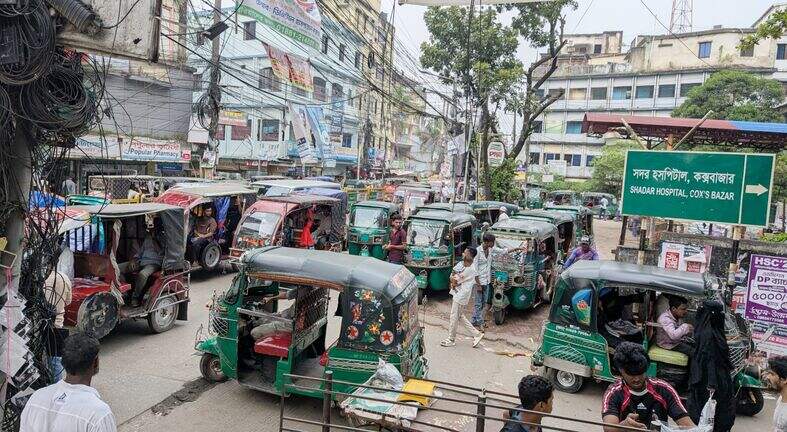
From the hotel-motel zone to the city’s main roads, traffic jams have become a regular feature. More than 23,000 three-wheelers operate on just 11 kilometres of municipal roads, while illegal parking, roadside stalls and encroachment on footpaths further narrow the already congested streets.
According to available information, more than 23,000 three-wheelers operate on the 11-kilometre road network within the Cox’s Bazar municipality. In addition, more than 400 long-distance public transport vehicles and over 5,000 minibusses, microbuses, CNG-run auto-rickshaws, cars and jeeps operate in and around the city.
During extended holidays, when an estimated five to six lakh tourists arrive in Cox’s Bazar, another 4,000 to 5,000 vehicles enter the city, worsening the congestion.
Traffic becomes particularly severe on holidays, with long queues forming from the hotel-motel zone to different parts of the city. People often spend hours on the road to reach restaurants, markets, or recreational spots.
Three-wheelers, locally known as tomtoms and e-rickshaws, are major contributors to the problem.
The city’s central bus terminal can accommodate only around 200 buses. The remaining vehicles are often parked along both sides of the bypass, Kolatoli and beach roads, reducing the usable width of the roads.
At the same time, hundreds of roadside and mobile shops have occupied parts of roads and footpaths, leaving little space for pedestrians and further slowing traffic.
Some of the worst congestion is reported at Jhautola, Ghumgachhtala on Airport Road, the Bholababu petrol pump area on Panbazar Road, the Fire Service area, Bazarghata, the Burmese Market area, Hospital Road, Bouddha Mandir Road, Kalur Dokan, Taraboniarchhara, Khurushkul Road intersection, Rumaliarchhara, Kolatoli bypass and Sugandha Road.
Mehedi Hasan, 24, a tomtom driver from Samitipara, said he used to work as a fisherman but turned to driving an e-rickshaw after losing his previous source of income.
“I earn around Tk1,400 a day, but I have to pay Tk600 to the vehicle owner as rent. I also pay Tk150 to the garage owner for battery charging,” he said.
Another e-rickshaw driver, Mohammad Rubel, 28, said passenger numbers were no longer as high as before despite spending the whole day on the road.
“The number of e-rickshaws has increased sharply, so competition among drivers for passengers has also increased,” he said.
Rafiqul Amin, 36, a tomtom driver from Kolatoli, said many people had entered the profession because it seemed like an effortless source of income.
“But as the number of vehicles has increased, our income has fallen. Previously, we could earn in a few hours what now takes a full day,” he said.
City officials said the number of e-rickshaws has far exceeded the permitted limit.
According to a municipal official, speaking on condition of anonymity, licenses were issued for around 3,000 e-rickshaws about 12 years ago. Another 500 licenses were issued recently, but more than 20,000 e-rickshaws are now operating in the city.
“Illegal e-rickshaws are occasionally seized during drives, but it has not been possible to bring the number under control,” the official said.
He said the number of e-rickshaws increased rapidly after August 5 last year, when traffic police were temporarily absent from the streets.
“Later, when traffic police began conducting drives against illegal vehicles, drivers staged road blockades and protests. Since then, effective enforcement against e-rickshaws has largely remained stalled,” he said.
Cox’s Bazar Additional Superintendent of Police (Traffic) Debdut Majumdar said police were working to control congestion while maintaining security in the city.
“Compared with the capacity of the roads, there are too many e-rickshaws, which is creating congestion at several important points,” he said.
He said licensed e-rickshaw drivers had been added to a database and joint drives were being conducted to prevent illegal vehicles from operating.
ANM Helal Uddin, president of the Cox’s Bazar Citizens Forum, said the number of three-wheelers had reached a level where pedestrians could barely find space to walk on some roads.
“It can sometimes take two to three hours to travel the roughly two kilometres from Lal Dighi Par to the Burmese Market,” he said.
He noted that traffic frequently trapped ambulances carrying critically ill patients, creating significant challenges for patients and their families.
“Teachers and students, government and private employees and people from all walks of life are suffering because of the congestion,” he said.
The growing number of battery-powered vehicles is also creating additional electricity demand.
Abdul Kader, executive engineer of the Cox’s Bazar office of Bangladesh Power Development Board, said around two to three megawatts of electricity were consumed daily to charge batteries of three-wheelers operating in the city.
“Batteries of these vehicles are charged at garages that have been established in different parts of the city,” he said.
Field visits found more than 300 garages in areas including Jhautola, Garir Math, Baidghona, Ghonarpara, Pahartali, the bus terminal, Samitipara, Kolatoli and Nazirartek, where batteries of tomtoms and mishuks are charged.
There are also allegations that some garage owners use illegal electricity connections to charge the batteries.
The congestion has become an additional concern for a city that depends heavily on tourism. During peak holiday periods, the combination of tourist vehicles, local public transport, roadside parking and pedestrian congestion puts further pressure on the limited road network.
To improve transport services and reduce inconvenience for tourists and passengers, the district police launched the country’s first digital platform, the “Online Bus Terminal”, on World Tourism Day on September 27, 2024.
However, the continuing growth in the number of three-wheelers, limited road capacity, and weak control over roadside parking and encroachment remain major challenges for Cox’s Bazar’s transport system.
By Tarekur Rahman
Photo: Tarekur Rahman