
More than 1,000 ponds have disappeared from Cox’s Bazar over the past 15 years, raising concerns over surface water availability, groundwater recharge, drainage and ecology.
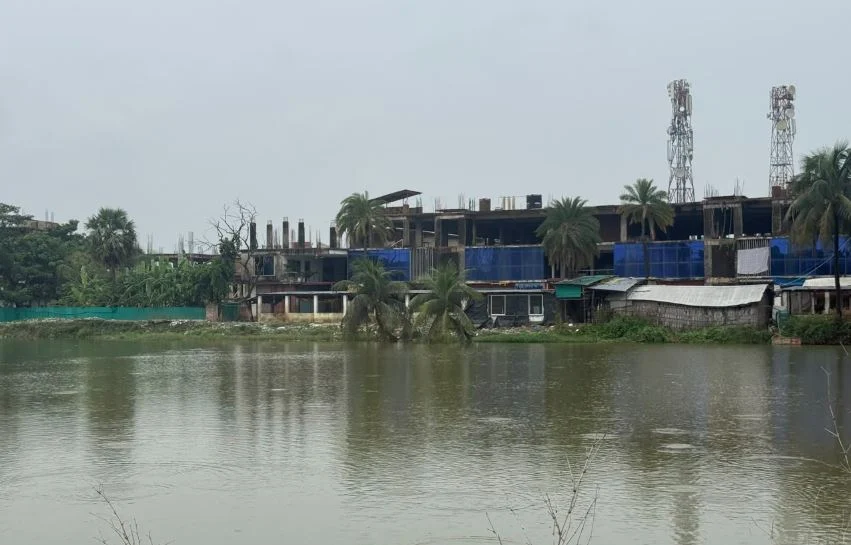
A 9.5-bigha government-owned pond beside Pekua Sadar Union Parishad in Pekua upazila is among the water bodies under threat, with parts of its banks have already filled over the past three years. Around 5,000 people use the pond daily, and 25,000-30,000 people use it on weekly market days.
Government records show that Cox’s Bazar had about 10,637 ponds in 2011, while only 9,560 ponds are now on the district fisheries office list. But local environmentalists say the district has no more than 7,000 ponds.
District Fisheries Officer Nazmul Huda alleged that influential people were filling both private and government ponds to build structures and develop residential plots.
Despite administrative drives, fines, and legal measures, pond encroachment has not stopped. In some cases, authorities have halted earth filling and restored ponds. But allegations of renewed encroachment came later.
Deputy Director of the Department of Environment (DoE), Cox’s Bazar office, Khandakar Mahmud Pasha said the department took immediate action whenever allegations of pond filling came to its notice.
Ponds are not merely places for storing water; each pond has its own ecosystem, he said, adding that ponds retain rainwater, reduce pressure on drainage systems and help regulate local temperature. He said the loss of ponds and wetlands is intensifying normal weather temperatures in the tourist city, devastating aquatic life and biodiversity.
Advocate Mujibul Haque, chairman of the environmental organisation Youth Environment Society (YES), said the decrease in water bodies, along with global climate change and land-use change, has aggravated temperature fluctuations.
Experts say at least 15 per cent of an urban area should be covered by water bodies. They warned that continued loss of water bodies has worsened water insecurity, waterlogging and heat-related problems in Cox’s Bazar.
The district is also facing an increasing shortage of safe drinking water as groundwater levels have declined across its nine upazilas and there is a lack of any water treatment plant.
Many shallow tube wells in different parts of Cox’s Bazar town have already become unusable. Groundwater levels are reportedly falling by 10-11 feet annually.
In Tekpara, groundwater that was available at a depth of 120-150 feet around a decade ago now requires drilling beyond 300 feet. In coastal Kalatali, groundwater levels have fallen by 10-15 feet in recent years, rendering many pumps at more than 300 feet redundant.
The DoE attributes the situation partly to excessive groundwater extraction and the filling of ponds and other water bodies.
The DPHE has undertaken a project to expand access to safe water, including a major initiative to treat water from the Bakkhali River. The project will treat around one million litres of water per hour and is expected to meet about 55 per cent of Cox’s Bazar municipality’s total demand.
Rainwater harvesting projects are also being implemented in different areas. In Ukhia and Teknaf, surface-water reservoirs and pipeline systems have been established to supply drinking water to local communities and Rohingya refugees.
Under the Natural Water Reservoir Conservation Act, 2000, filling ponds, wetlands, rivers and canals is prohibited. But rampant encroachment of ponds and water bodies is going on in the city.
Cox’s Bazar Life Desk/BSS