
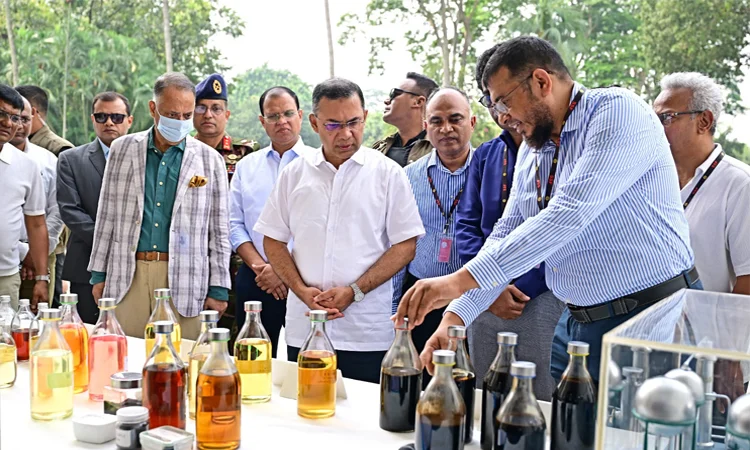
Prime Minister Tarique Rahman on Saturday viewed a demonstration of an innovative project that produces fuel oil from human waste and agricultural residues and assured the researchers of full government support to realise its potential.
If successfully commercialised, the technology could reduce dependence on imported crude oil, save foreign exchange, improve waste management, and curb environmental pollution.
The prime minister gave the assurance while viewing the project’s demonstration at his office in Tejgaon here this morning by project researcher and Khulna University of Engineering and Technology (KUET) Professor Dr Md Khalekuzzaman, said PM’s Deputy Press Secretary Md Suzauddhowla (Sujan Mahmud).
During the programme, Dr Khalekuzzaman briefed the prime minister on the technology, research progress and prospects for commercial production of fuel oil from human waste, sewage treatment plant waste, kitchen waste and agricultural residues.
The prime minister was also briefed on its potential to strengthen the country’s energy security and improve waste management.
Later, he assured the researchers of the government’s full support to implement the project, given its potential.
The KUET researchers have made significant progress over nearly a decade of research in producing organic crude oil, or biocrude, from waste using Hydrothermal Liquefaction (HTL) technology.
Laboratory tests have produced biocrude at a rate of 50 to 55 percent, while the researchers have also achieved success in producing diesel-rich biocrude, they informed the prime minister.
Next, the researchers plan to establish a pilot plant capable of processing one to three tonnes of waste daily.
The pilot plant will be used to assess the technology’s effectiveness, production costs and commercial viability.
The pilot project is estimated to cost Tk 100-120 crore.
The researchers said that if the technology could be successfully scaled up for commercial production, it could potentially replace around 10 to 15 per cent of the country’s imported crude oil in the future.
This could help save an estimated Tk 6,500 crore to Tk 13,000 crore in foreign exchange annually, they said. However, they noted that the potential could only be realised after assessing the technology’s large-scale performance and economic viability.
The researchers expressed hope that successful commercialisation of the technology with government support would play an important role in addressing the country’s fuel oil and waste management challenges.
They said the initiative could reduce dependence on imported fuel, save foreign exchange, reduce environmental pollution, and create new opportunities to develop a domestic fuel industry.
Power and Energy Minister Iqbal Hassan Mahmood Tuku, State Minister Aninda Islam Amit, University Grants Commission (UGC) member for Public Management Prof Dr Abdullah-Al-Mamun, KUET Vice-Chancellor Prof Muhammad Masud, and Bangladesh Petroleum Corporation (BPC) Chairman Dr Md Rafiqul Islam were present.
Cox’s Bazar Life Desk/BSS