
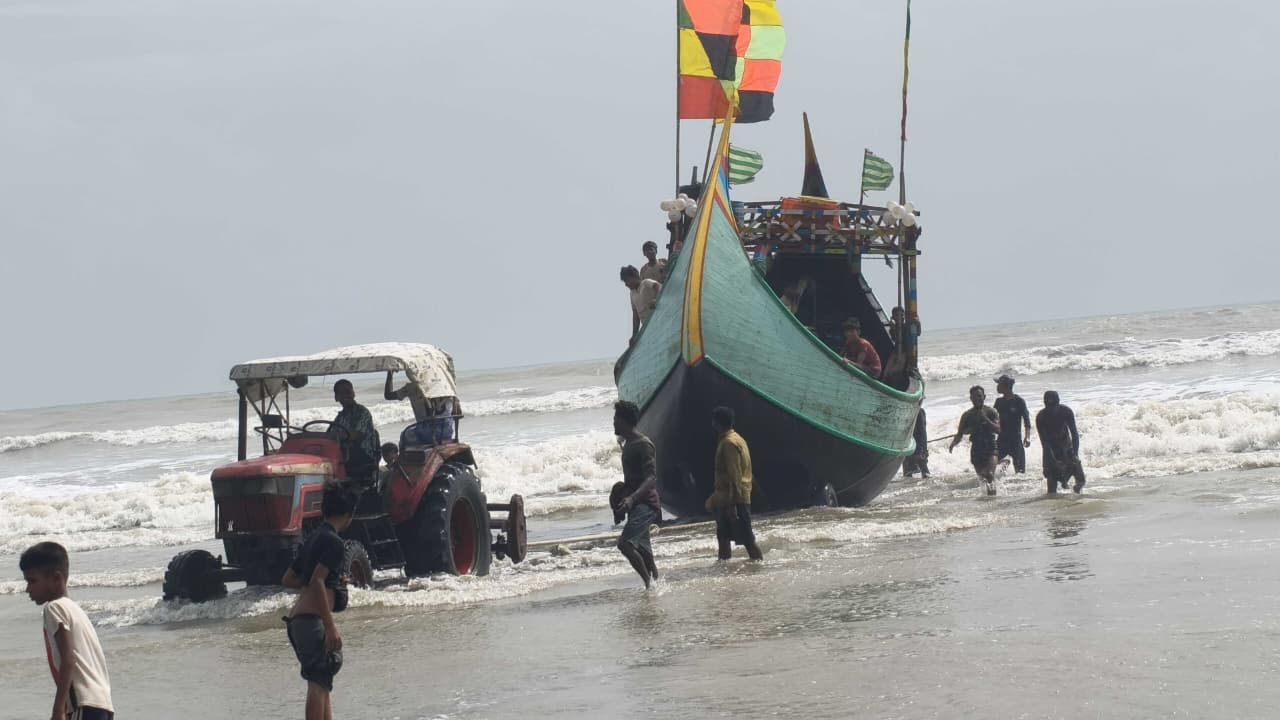
Four fishers went missing when a fishing trawler, FB Tahsin, owned by Faridul Alam, capsized amid strong winds and rough waves in the Sonadia Channel off Kutubjom union in Moheshkhali early on September 3. Four of the eight crew members swam ashore, while rescuers later recovered the bodies of Foyez Ahmed and Saiful Islam.
Nurul and Muhib remained missing. None of the fishers aboard was wearing a life jacket. The four survivors saved themselves by clinging to floating objects.
Despite such accidents along the Cox’s Bazar coast, no effective system ensures fishing trawlers carry life jackets and other safety equipment before heading out to sea. Weather warnings also often fail to reach fishers in deep waters, while the relevant authorities lack comprehensive records of how many fishers die or go missing each year.
Nurul Bashar, president of the Cox’s Bazar Majhi-Malla Sramajibi Cooperative Society, said mobile network coverage was unavailable in deep waters, preventing fishers from receiving weather updates in time.
“Fishers have to rely on their experience to assess sea conditions and decide when to return. He noted that meetings and seminars raise safety concerns, but they often result in little more than assurances.
District fisheries officer Md Nazmul Huda said some devices previously distributed to fishers had become unusable, and plans were under way to introduce new AI devices.
BIWTA sub-inspector Tozammel Hossain said more than 12,000 trawlers in the country had route permits, while many trawlers in Cox’s Bazar lacked proper fitness certification and licenses.
64,000 fishers depend on a thin workforce
According to the district fisheries office, Cox’s Bazar has 5,250 registered fishing trawlers and 64,428 registered fishers. The number exceeds 100,000 when unregistered fishers are included.
However, 48 of the district fisheries office’s 72 sanctioned posts remain vacant. Only 24 officials are working, including eight at the district office and 16 at upazila offices. Not all of them handle field-level monitoring.
Kutubdia and Teknaf have only one fisheries worker each, while Maheshkhali has three. No fisheries workers are assigned to Eidgaon or the newly formed Matamuhuri upazila.
The limited workforce has to manage hatcheries, fingerling production, fishing bans, dried-fish activities, training, and the registration of boats and fishers, among other responsibilities.
The district fisheries office estimates that seven to eight trawlers capsized along the coast over the past year. However, it does not have complete records of deaths, injuries and missing fishers.
On July 13, a trawler carrying 12 fishers capsized near Kutubdia. Seven returned, but five went missing. Four bodies were later recovered, while Nasir Uddin of Magnama in Pekua remained missing.
Another trawler capsized near Amjakhali in Kutubdia on January 9. Eight people were rescued injured, two bodies were recovered, and 12-year-old fisher Foysal remained missing.
The district fisheries office said it had received reports of 20 casualties in separate accidents this year but could not provide detailed information. Meanwhile, some upazila fisheries offices said they had no records of trawler capsizes or missing fishers.
No system to ensure life jackets
District fisheries officer Nazmul Huda said the fisheries office was not responsible for making life jackets mandatory on fishing trawlers.
However, he said checkpoints could help authorities inspect safety equipment before boats departed.
Ali Azgar, skipper of the fishing trawler Mayer Doya, also said risks could be reduced by ensuring fishers received weather warnings promptly and used life jackets and other safety equipment.
Fishing trawlers should carry life jackets, lifebuoys, firefighting equipment, communication and navigation devices, and first-aid supplies. But a visit to the fishing landing centre found that such equipment was not adequately present.
The fisheries department could not provide clear figures on how many trawlers had been inspected over the past year, how many were found lacking safety equipment or what action had been taken.
A Coast Guard official said inspections were conducted, but it was not possible to ensure every trawler was fully equipped with safety gear.
The district fisheries office said the government provided Tk50,000 to the family of a registered fisherman killed in an accident and Tk30,000 to an injured fisher.
Those concerned said increasing manpower, conducting regular trawler inspections, ensuring safety equipment is available and used, providing training, delivering timely weather warnings, and maintaining accurate accident records were essential to reducing risks for fishers.
By Tarekur Rahman
Photo: Tarekur Rahman