
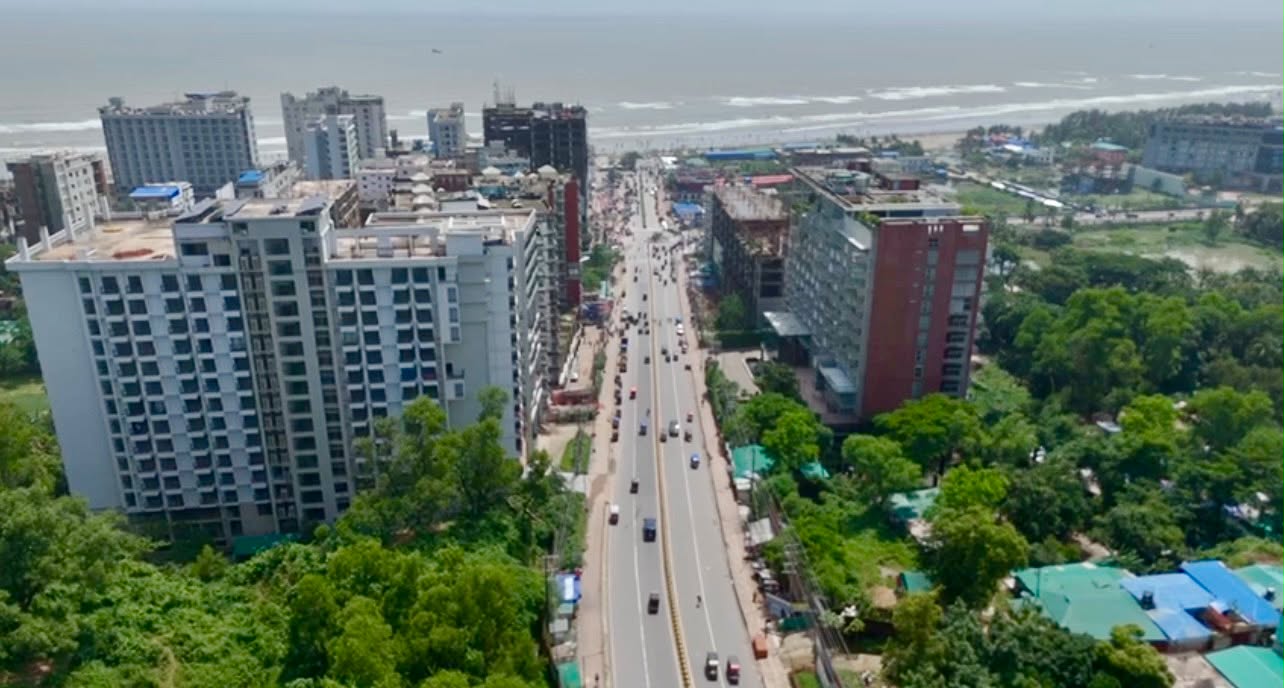
Local residents, young people and business owners have welcomed an initiative to upgrade Cox’s Bazar municipality to a city corporation, expecting improved civic services, expanded business opportunities, tourism growth and planned urban development.
They have, however, stressed the need to protect the environment, build sustainable coastal embankments and safeguard the livelihoods of marginalised people.
Local youth climate activist Shah Rukh Karim emphasised that establishing a city corporation should be accompanied by environmentally friendly, sustainable urbanisation.
He stressed the need to protect the ecological balance, build sustainable embankments, and strengthen coastal protection.
College student Ahsan Habib said the initiative offered hope for young people, expressing expectations of better roads, a cleaner environment, improved waste management and modern civic services.
Local businessman Nurul Bashar said a city corporation could accelerate business activities in Cox’s Bazar.
He expected tourism-related businesses to expand and the local economy to benefit from improved infrastructure and civic amenities.
The process of upgrading Cox’s Bazar municipality has formally advanced a step further, with the district administration issuing a public notice seeking to establish the proposed city corporation.
The proposed city corporation would encompass the existing municipality and designated areas of five neighbouring unions. It would cover an estimated 169.64 square kilometres and have a population of around 1.08 million.
The public notice, signed by Cox’s Bazar Deputy Commissioner Md Abul Mannan on August 31, was published recently.
Beyond the municipality, the proposed boundary includes specified areas of the Jhilongja, Khurushkul, PM Khali, South Mithachhari, and Khuniapalong unions.
The notice also provides details of 12 relevant mouzas, including their mouza and plot numbers.
Under the proposed boundaries, 32.90 square kilometres of the municipality, 20 square kilometres of Jhilongja, 23.67 square kilometres of Khurushkul, 27.25 square kilometres of PM Khali, 18 square kilometres of South Mithachhari and 47.82 square kilometres of Khuniapalong would be included.
According to the notice, the initiative follows an August 12 directive from the City Corporation-2 branch of the Local Government Division and the provisions of Rule 5(2) of the Local Government (City Corporation) Establishment Rules, 2010.
Anyone wishing to raise an objection or submit an opinion on the proposed boundaries or areas may do so in writing to the deputy commissioner within 30 days of publication of the notice.
The notice states that no objections will be accepted after the deadline.
Earlier, the administration prepared a report detailing the municipality and the proposed expanded area, including its size and population, as part of the process.
The relevant documents bear the signatures of municipal assistant engineer Romel Barua, chief executive officer Md Adnan Chowdhury and administrator Md Shamim Al Imran.
Deputy Commissioner Md Abul Mannan assured that the government would seriously consider and convey citizens’ demands.
He said the government would decide in accordance with relevant laws and regulations, taking into account what best serves the interests and welfare of the people of Cox’s Bazar.
He added that once an area is incorporated into a city corporation, the corporation would be responsible for roads, infrastructure, and various civic services.
Residents would also have to pay prescribed fees, holding taxes and other revenues.
He said the city corporation’s establishment should also take into account citizens’ responsibilities and financial capacity.
Cox’s Bazar-3 lawmaker Lutfur Rahman Kajal said authorities should give due consideration to public opinion and the protection of marginalised communities’ interests when determining the proposed boundaries.
He expressed hope that discussions, debates, and consultations with all relevant stakeholders would finalise the boundaries.
While expanding the geographical area might be relatively straightforward, he said authorities should carefully assess whether the additional costs of civic services would place a greater burden on farmers and other marginalised people.
Established in 1965, Cox’s Bazar municipality has expanded in area and population over the years.
However, complaints persist that civic services have not kept pace with the growing needs of residents and tourists. Local people have long demanded that the tourist town be upgraded to a city corporation.
The proposed upgrade could create opportunities to expand planned urban development, road connectivity, waste management, water supply and other civic services, along with supporting tourism infrastructure and attracting investment.
However, whether the initiative can transform Cox’s Bazar into a modern and inclusive urban centre will depend on how authorities address boundary determination, sustainable development, environmental protection and the potential financial burden on residents.
By Mohammad Morshed
Photo: Mohammad Morshed