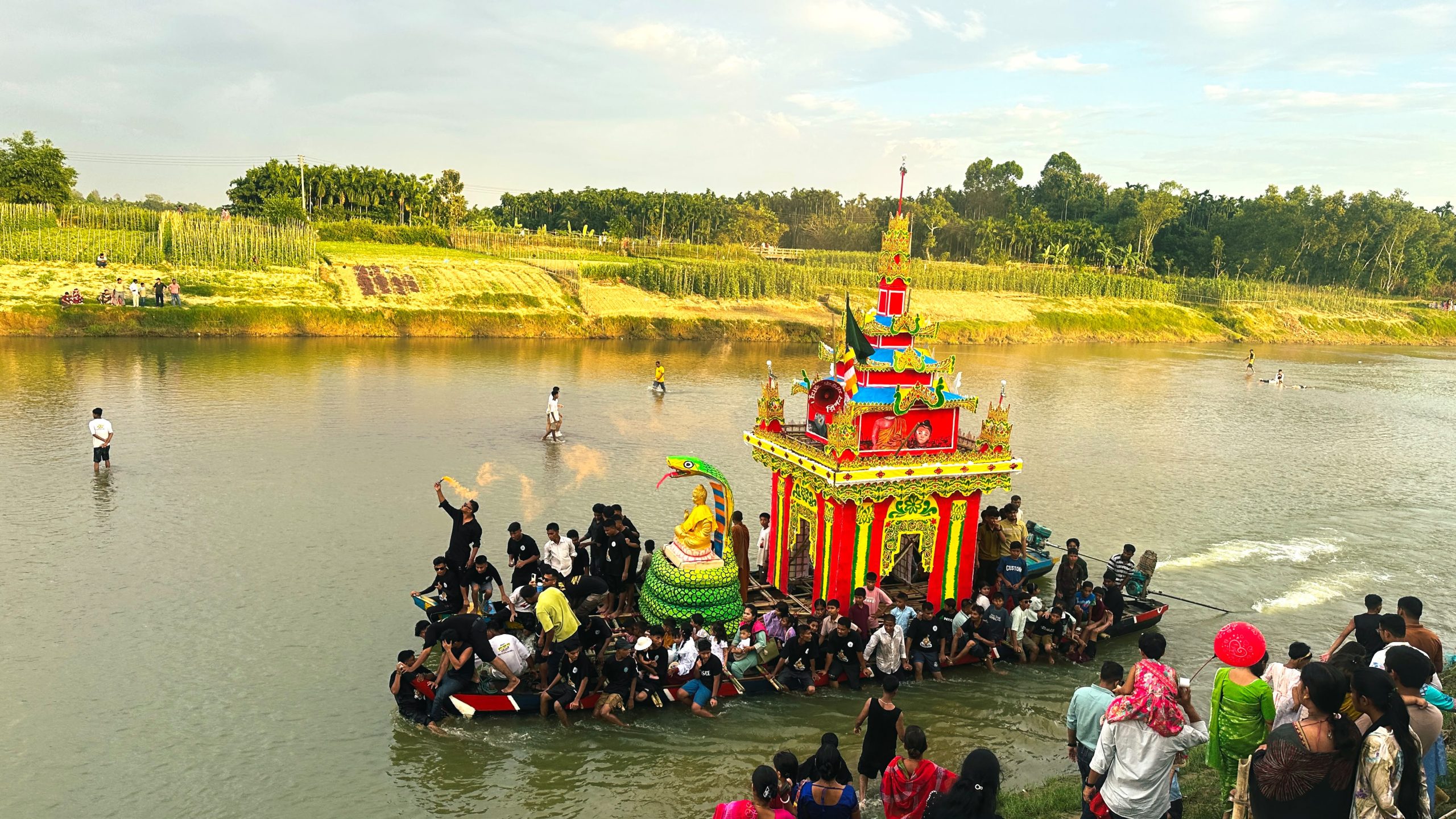
Thousands of people gathered on both banks of the Bakkhali River in Ramu, Cox’s Bazar, on Monday to witness the traditional Kalpo Jahaj Bhasa Festival, as seven colourful symbolic vessels were set afloat to mark the final day of Prabarana Purnima, one of the major religious festivals of the Buddhist community.
Crafted from bamboo, wood, cane and coloured paper, the vessels featured elaborate designs depicting mythical birds, elephants, peacocks, pigeons and Buddhist figures.
Although they resembled real ships, they were symbolic creations made for the festival.
Devotees brought the vessels to the riverbank by van, then placed them on boats and set them afloat.
According to their religious beliefs, the vessels drift downstream until they disappear, symbolically reaching heaven.
The festival was held at Cheranghata on Monday afternoon. The event included religious rituals, songs, dances, and Buddhist devotional performances, attracting a diverse audience.
The program began around 4:00 pm, with seven decorated vessels set afloat on five to six wooden boats, two of which were engine-powered. Images of animals and religious symbols adorned the structures.
As the vessels entered the river, Buddhist men and women celebrated with songs and dances, while others played drums, cymbals and traditional musical instruments.
Children and teenagers also joined the celebrations.
State Minister for Cultural Affairs Ali Newaz Mohammad Khaiyam attended the festival as the chief guest.
“We are all one, regardless of religion or ethnicity. People from the hills and the plains are one. There is no division among us,” he said.
Other guests included Cox’s Bazar-3 lawmaker Lutfur Rahman Kazal, Jyotisen Mahathero, director of Rangkoot Buddhist Monastery in Ramu, and Ekushey Padak-winning educationist Professor Sukomal Barua.
Susmita Barua, who travelled from Chattogram to attend the festival, said she came to Ramu after celebrating Prabarana in her area to take part in the Kalpo Jahaj Bhasa festivities.
University student Nandani Barua described the festival as an integral part of the community’s cultural life.
Pragyananda Bhikkhu, the residential head of Merongloa Central Seema Mahavihara, said the tradition began around 200 years ago in neighbouring Myanmar.
According to him, a ruler named Mongraj Mrajonbran first organised the festival at a place called Murhon Gha.
Explaining its religious significance, Pragyananda Bhikkhu recounted a Buddhist tradition associated with Gautama Buddha’s journey from Rajagriha to Vaishali.
According to Buddhist accounts, Vaishali suffered drought, famine and hardship around 2,500 years ago. At the king’s invitation, Buddha traveled there with his disciples and recited the Ratana Sutta, which is believed to have helped save the kingdom from the crisis.
The festival is held on the final day of Prabarana Purnima, after Buddhist devotees complete their three-month rains retreat.
By Abdu Rashid Manik
Photo: Abdu Rashid Manik