
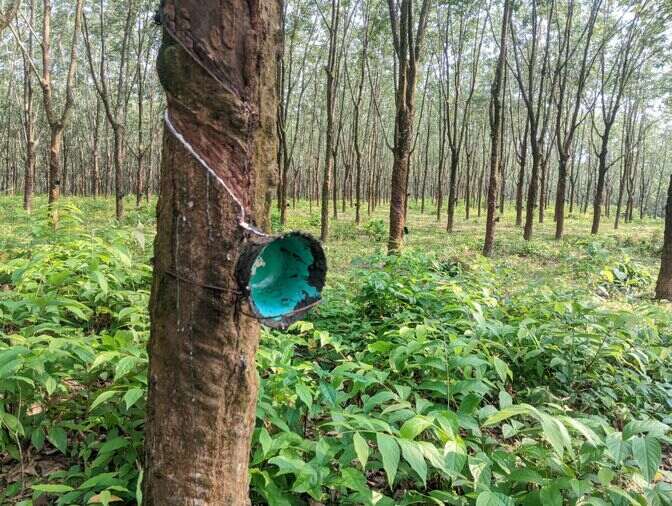
The sap of rubber trees, a white liquid closely resembling milk, yields rubber. Rubber production relies heavily on this sap, also known as latex, often called “white gold.” Rubber trees thrive in the temperate regions of the world.
Just 17 kilometers from Cox’s Bazar lies the rubber plantation in Ramu. The lush green rows of rubber trees offer a serene escape at nature. 1960-61, following a survey of unused land, the first rubber cultivation in Ramu began on 2,682 acres.
The factory collects latex from rubber plantations and places it in containers for processing. It adds water and a chemical to coagulate the latex and then pours it into trays to set. The latex solidifies after three hours, but we leave it overnight to rest. The next day, the rubber is removed from the trays and passed through plain and grooved rollers to drain water.
Next, they hang the rubber to dry for a day and then move it to the smokehouse, where heat and smoke from a wood-fired furnace dry it at 40°C for 72 hours. The process transforms the rubber into a form akin to chocolate, which undergoes three grading stages.
By Rajin Saleh