

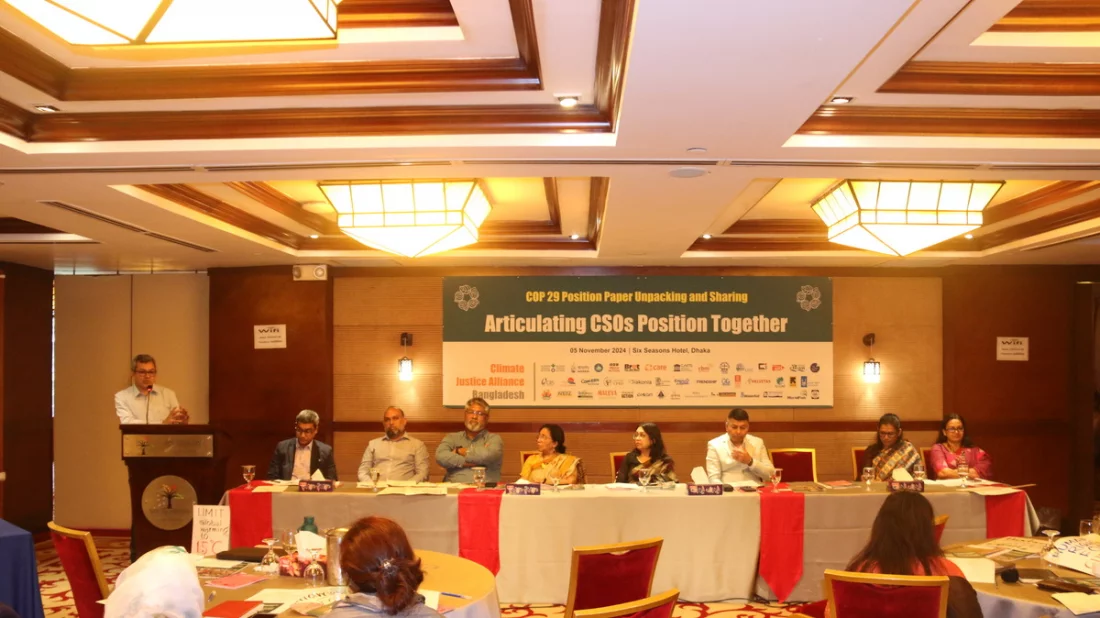
In a recent event organized by the Climate Justice Alliance-Bangladesh, a coalition of 40 civil society organizations (CSOs) led by the Center for Participatory Research and Development (CPRD), participants called for the establishment of an annual Loss and Damage fund of $400 billion by 2025. The event, held on Tuesday at the Six Seasons Hotel in Dhaka, aimed to share the alliance’s position paper and outline key demands ahead of COP 29.
Titled “COP 29 Position Paper Unpacking and Sharing: Articulating CSOs Position Together,” the gathering underscored the urgent need for global financial and technical support aligned with the 1.5°C temperature goal. The alliance demanded that COP 29 commit to ambitious Nationally Determined Contributions (NDC-3) and establish a clear timeline for fossil fuel phase-out, prioritizing low-income and climate-vulnerable countries.
In addition to calling for a comprehensive framework for Loss and Damage, the alliance also demanded a new, more effective climate finance model. This model would include a standardized framework for climate finance with the New Collective Quantified Goal (NCQG) based on grants and concessional financing.
Md Shamsudohha, chief executive of CPRD and coordinator of Climate Justice Alliance-Bangladesh, argued for predictable and need-based financing to support low-income nations in transitioning away from fossil fuels and enhancing resilience to climate change.
The alliance also pushed for an international framework under the United Nations Framework Convention on Climate Change (UNFCCC) to address climate-induced human rights impacts. This would involve conducting global research on the intersection of climate change and human rights and establishing legal safeguards.
Further, the alliance highlighted the importance of transboundary climate adaptation. Drawing on examples such as the Indus Waters Treaty and the Mekong River Commission, Shamsudohha called for a binding framework under the Global Goal on Adaptation to advance cooperation on issues like data sharing and early warning systems.
The event featured other prominent figures, including Sharif Jamil, Hasin Jahan, Juliate Keya Malakar, and Prashant Verma, who all echoed the need for decisive action at COP 29. They emphasized the importance of creating a gender-responsive climate finance framework and establishing guidelines for addressing climate-induced human mobility.
By Saddam Hossain