
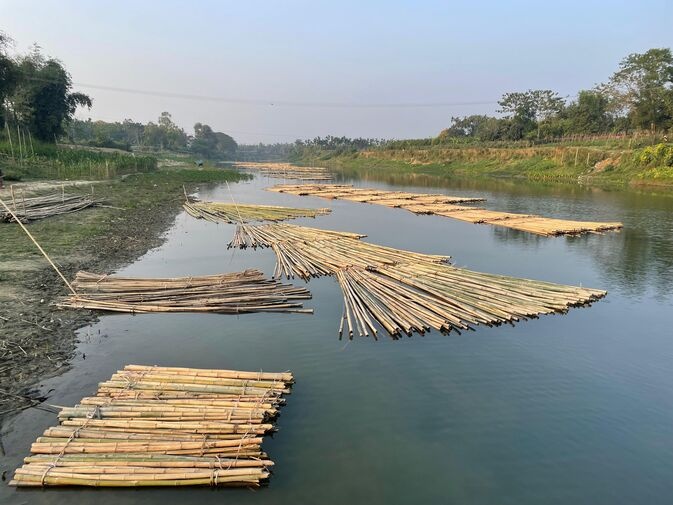
Bound together from dozens of sturdy poles, the raft is more than a simple bamboo structure — it is a vivid portrait of life shaped by hills, rivers, and human labour.
In the forested, green hill tracts of south-eastern Bangladesh — particularly Bandarban and Cox’s Bazar — strong, long and durable bamboo is harvested from the hills. After collection, the bamboo is transported down mountain slopes along streams and small channels, eventually reaching the Bakkhali River. At that point, the river becomes not merely a waterway but a vital transport route.
Once the bamboo reaches the river, workers begin the process of assembling the rafts. With skilled hands, they arrange around 50 bamboo poles in parallel and bind them tightly with rope or split bamboo strips to form a single raft. Then, two of these rafts are placed side by side and linked in rows, one after the other. In this way, several units are joined to create a long and expansive floating structure that can drift smoothly along the river.
These rafts are not merely a means of transport; they are an integral part of the local economy. The age-old method of floating bamboo downstream offers a cost-effective alternative to road transport, particularly in areas with limited road infrastructure or high road-use costs.
Parts of Ramu upazila in Cox’s Bazar often witness such rafts on the Bakkhali River. In the Rajarkul area, especially while crossing the bamboo bridge, long lines of bamboo floating on the water come into view — a symbol of labour and livelihood carried by the river’s current. From a distance, the sight resembles a moving stretch of green across the river’s surface.
While the scene is familiar to local residents, it offers a unique experience for visitors. The raft, born of nature and sustained by human effort, represents a living rural tradition.
Bamboo remains a versatile resource in rural Bangladesh, widely used in housing, bridges, furniture, and various forms of construction. Within that continuum, the bamboo raft stands not only as a means of transport but also as an expression of local knowledge and intergenerational skill.
Environment-friendly, low-cost and effective, the practice also holds relevance from a sustainable development perspective. With proper planning and management, it could even emerge as a tourism attraction, particularly in river- and hill-based travel circuits in the greater Cox’s Bazar region.
From hills to river, and from river to settlement, the bamboo raft serves as a living bridge — carrying with it nature’s bounty, human toil, and the timeless rhythm of riverine Bangladesh.
By Abdu Rashid Manik
Photo: Abdu Rashid Manik