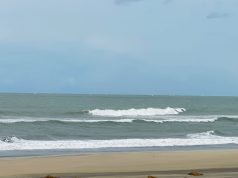


On 23 October 1995, a young tourist, Minhaz Yasser, went swimming at Laboni Point on Cox’s Bazar sea beach. He was swept away by the waves and died.
The tragic death of the young man changed the history of safety management at Cox’s Bazar beach.
Exactly a year later, on 23 October 1996, the country’s first lifeguard service was launched at Laboni Point in memory of Minhaz Yasser. The service was initiated by Duncan Group, where Yasser’s father, Sahabuddin, worked, and was named Yasser Lifeguard.

Nearly three decades have passed since then. Yasser Lifeguard has played a role in saving the lives of countless tourists at Cox’s Bazar beach.
But the country’s first lifeguard service is now itself facing an uncertain future, with a shortage of personnel and limited operations.
The Yasser Lifeguard office is located beside the Tourist Police Cox’s Bazar Region office at Laboni Point. A two-storey building has been constructed on a large plot allocated by the government.
However, outsiders are currently using parts of the building for sleeping, and an abandoned speedboat lies outside the premises.
Mizanur Rahman, in charge of Yasser Lifeguard, said the service currently employs six people, but only four serve as lifeguards.
“With such a large number of tourists on the beach, it is extremely difficult for four lifeguards to perform their duties across different points,” he said.
“It is not possible to run the service properly with only four lifeguards. If the necessary workforce is increased, the service can become active again,” he added.
Ihtesham Mashhud Chowdhury, Chattogram regional head of operations at Duncan Brothers, said Yasser Lifeguard had saved many lives over the years.
“The company does not receive any financial benefit from this service. So, there is currently no initiative to expand its operations,” he said.
Lifeguard services shrinking
The current state of Yasser Lifeguard, which began as the country’s first lifeguard service, has raised questions over tourist safety at Cox’s Bazar beach.
Millions of tourists visit the beach every year, yet one of the most important safety services for them has gradually been shrinking.
From 1996 to 2026, five lifeguard services have operated at Cox’s Bazar beach at different times. Yasser Lifeguard has continued operating for most of this period.
Meanwhile, Banglalink’s Green World Lifeguard, SeaLine Lifeguard and Robi Lifeguard have discontinued their operations.
Sea Safe Lifeguard, operated by the private organisation CIPRB since 2014, continues to provide services at the beach. However, its operations also face the threat of being suspended each year due to financial constraints.
Mohammad Osman, supervisor of Sea Safe Lifeguard, said many lifeguards had left the profession because of financial insecurity.
“If there is no government support, lifeguarding services could disappear in the future,” he said.
Tourist Safat Islam, who was visiting Laboni Point, said lifeguards were essential for tourists who enter the sea.
“It is crucial to have lifeguards when tourists go into the sea. But they are not visible at many places. As a result, tourists have to be extra cautious themselves,” he said.
Another tourist, Subeh Sadik Islam, said it was difficult to predict how the waves could change.
“Lifeguards are particularly important for people who do not know how to swim. There should be enough lifeguards at every important point of the beach,” he said.
Local visitor Minhaz Uddin said many people are injured or killed in sea accidents every year.
“Many accidents could be prevented if lifeguards were present. The service therefore needs to be strengthened,” he said.
Nazrul Islam, member secretary of Cox’s Bazar Nagarik Andolon, said the tourism sector generated substantial revenue every year, but there was no permanent government initiative to ensure tourists’ safety.
“Lifeguard services should be brought under government management,” he said.
78 deaths in 13 years
More than 500 hotels, motels and guesthouses have been built around Cox’s Bazar beach, drawing millions of tourists every year to what is widely described as the world’s longest uninterrupted natural sea beach.
Yet, despite the huge tourism infrastructure, people continue to lose their lives after entering the sea.
According to Sea Safe Lifeguard data, 78 people died while swimming at Cox’s Bazar beach between 2014 and 2026.
The death of one young man led to the creation of Yasser Lifeguard in 1996.
Three decades later, that very lifeguard service is struggling with a shortage of personnel.
Once established to protect tourists from the dangers of the sea, Yasser Lifeguard itself is now gradually losing capacity.
The question therefore remains: if lifeguard services continue to weaken, who will be responsible for tourists’ safety at Cox’s Bazar beach?
By Abdur Rashid Manik
Photo: Abdur Rashid Manik