
Once spread over around 21,000 acres in Chakaria, Cox’s Bazar, the Chakaria Sundarbans was an important mangrove forest in the country’s south-eastern region. Rich in sundari, gewa, keora, pasur and golpata trees, the forest was home to tigers, deer, wild boars and various bird species. It also served as a fish breeding ground.
But the expansion of commercial shrimp farming and the leasing of forestland have turned most of the forest into shrimp enclosures. Recent moves towards restoration have raised hopes, but experts say reclaiming the land, cancelling leases and adopting a long-term plan are essential to bringing the forest back.
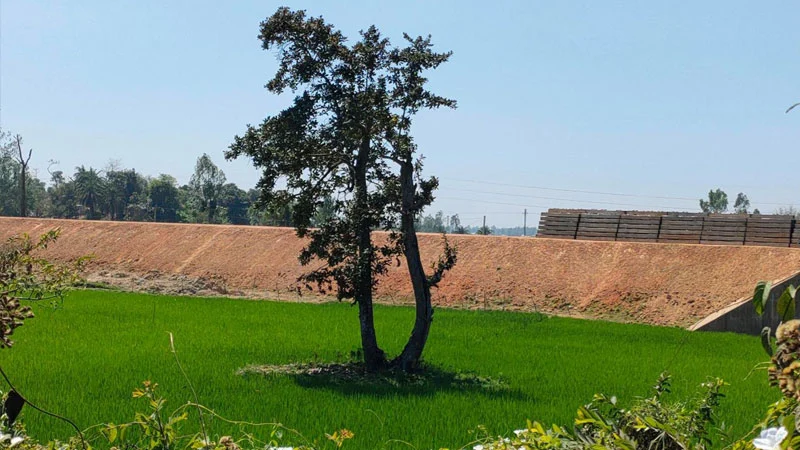
A lone sundari tree stands beside the Cox’s Bazar–Chattogram highway near Natun Masjid in Fashiakhali, about seven kilometres from the Chakaria upazila headquarters. The Dohazari–Cox’s Bazar railway line runs nearby. No forest surrounds the tree, and no birdsong fills the air. It remains a reminder of the Chakaria Sundarbans that was lost.
In the 1950s, the forest covered around 21,102 acres. Later, 18,508 acres were declared reserved forest, while the remaining area was classified as protected forest.
Forestland leasing began in 1977. The destruction accelerated after a 1985 shrimp farming policy created opportunities to lease forestland suitable for shrimp cultivation.
Environmentalists say the forest disappeared over several decades because of the expansion of commercial shrimp farming, policy decisions and land grabbing.
Following a writ petition seeking to restore the forest, the High Court issued a rule on July 19 on the notification to de-reserve the forest and the failure to recover the forest land. The court also sought explanations regarding the cancellation of illegal leases and the eviction of unauthorised occupants.
Cox’s Bazar South Forest Division divisional forest officer Md Maruf Hossain said that cancelling leases granted for shrimp cultivation was the first step towards restoring the Chakaria Sundarbans.
“The matter involves a policy decision,” he said.
In June, then assistant commissioner (land) Rupayan Deb submitted a report on the Chakaria Sundarbans to the upazila nirbahi officer. The report recommended recovering outstanding land revenue and compensation, taking action on occupied leased land, establishing a police outpost, and revising the shrimp-lease management policy.
It also proposed that the government coordinate with the relevant ministries to determine its position and present it to the High Court.
According to the Forest Department, 80,000 bain trees have been planted on 25 acres of land along the Badarkhali Channel. The reported survival rate has been encouraging, raising hopes for restoration.
Another 40,000 bain trees were planted on a further 25 acres in June this year.
Experts, however, say planting trees alone will not be enough. The land must first be recovered, and efforts must be made to restore the ecosystem’s natural conditions.
Lawyer Mujibul Haque, chairman of the Youth Environment Society, said the forest’s destruction damaged local fuel sources and natural fish resources, deprived forest-dependent people of their livelihoods, and harmed biodiversity.
He said the loss also weakened the natural protective barrier that shields coastal areas from cyclones and tidal surges.
HM Nazrul Islam, organising secretary of the Cox’s Bazar district committee of Bangladesh Poribesh Andolon, said local communities and their livelihoods must be considered in any restoration plan.
Alongside land recovery and resolving lease-related complications, he said alternative livelihood opportunities should also be considered.
Experts say mangrove forests and shrimp farming can coexist under a planned system known as silvofishery. Such an approach could allow shrimp cultivation to continue while protecting forests and biodiversity.
However, we must first identify areas suitable for conserving natural forests and establishing new mangrove plantations.
The coastal areas of Chakaria and Pekua are vulnerable to cyclones and tidal surges. Mangrove forests help reduce the impact of strong winds and waves while supporting fish breeding and biodiversity.
Those involved in the restoration effort say recovering forestland, cancelling leases, coordinating government agencies, and ensuring local participation could help restore the Chakaria Sundarbans.
By Tarekur Rahman
Photo: Collected