

Maritime experts and policymakers today called for strategic investment in deep-sea fishing, marine biotechnology, and value-added seafood processing, saying Bangladesh could unlock a Blue Economy worth up to US$18 billion annually through coordinated policies and private-sector participation.
They were speaking at a seminar titled “Investment Potential in Fisheries and Marine Economy in Bangladesh”, organised jointly by the Maheshkhali Integrated Development Authority (MIDA) and the Japan International Cooperation Agency (JICA) Bangladesh at a hotel in the capital.
The seminar brought together policymakers, senior government officials, development partners, fisheries experts, industry leaders, entrepreneurs and prospective investors to examine how Bangladesh can unlock higher-value investment in its fisheries and marine economy.
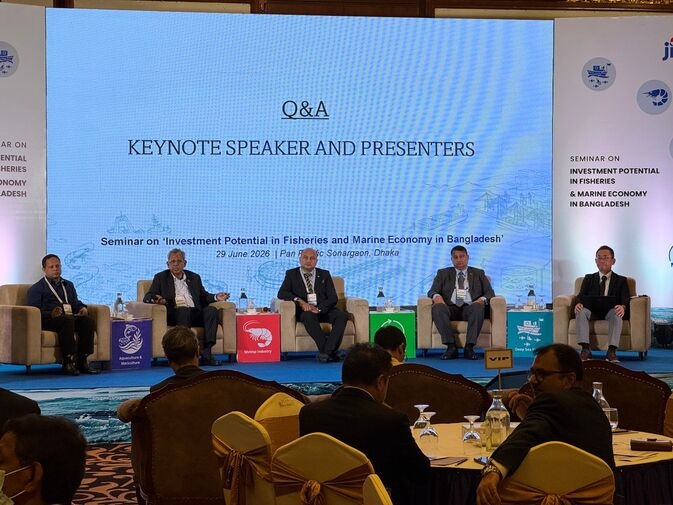
The seminar focused on four high-potential areas where Bangladesh has significant resource depth but limited commercial scale: deep-sea fishing, mariculture, aquaculture and shrimp, and seafood processing. Discussions highlighted the scope for investment in industrial fishing fleets, offshore operations, landing and logistics systems, commercial mariculture, certified shrimp value chains, cold-chain infrastructure and modern seafood processing facilities.
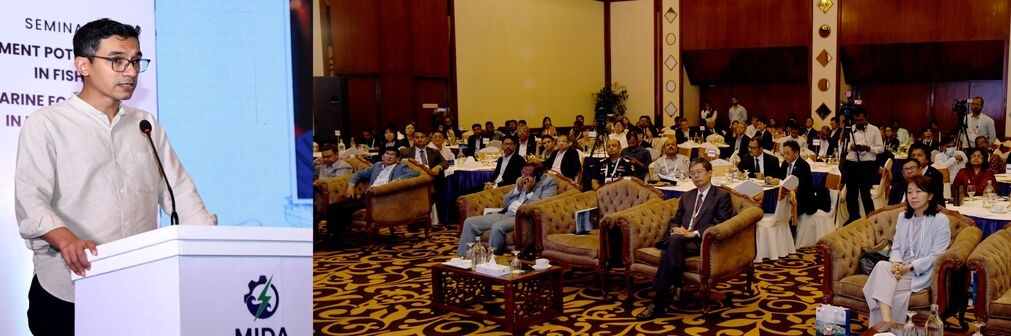
Speaking at a seminar, MIDA Executive Chairman Chowdhury Ashik Mahmud Bin Harun said Bangladesh have to shift from a land-centric development model to one that recognises the Bay of Bengal as a key driver of future economic growth.
“Fisheries, seafood processing, logistics and exports form a single integrated value chain that requires coordinated support from different government agencies,” he said.
Describing Matarbari and Moheshkhali as strategic hubs for future marine industrial development, Ashik Chowdhury said that MIDA is working to align policies across the concerned ministries to create an integrated investment package tailored to private-sector needs.
He expressed optimism that Bangladesh could emerge as a major global fishing exporter within the next three to five years through coordinated government action and private investment.
At his keynote speech, Rear Admiral (Retd.) Khurshed Alam said that Bangladesh currently generates around US$6 billion from its marine resources but has the potential to double or even triple that figure through sustainable exploitation of ocean resources.
He said the country’s future Blue Economy should be built on four pillars: harmony with nature, climate neutrality, sustainable coastal communities and integrated governance.
Highlighting Bangladesh’s untapped marine resources, Khurshed Alam said that marine fisheries account for only 15-16 per cent of the country’s fish production despite its vast maritime area.
He noted that traditional fishing vessels operate only 20 to 40 kilometres offshore, leaving much of the Exclusive Economic Zone underutilised.
He urged entrepreneurs to invest in modern deep-sea fishing vessels, saying commercially valuable tuna and several other large fish species remain largely unexplored in Bangladesh’s waters.
The maritime expert also stressed the potential of marine biotechnology, saying that sea-based resources could support the production of pharmaceuticals, Omega-3 supplements, cosmetics, and agar from seaweed, as well as livestock and fish feed, creating new export opportunities while reducing import dependence.
Drawing lessons from Iceland’s fisheries sector, Khurshed Alam said Bangladesh could significantly increase export earnings by ensuring value addition and utilising every part of harvested fish for high-value industrial and pharmaceutical products.
He also called for financial incentives for the marine industry, improved infrastructure in coastal and island areas, faster implementation of deep-sea fishing initiatives, and greater media attention to the country’s maritime economy.
The seminar brought together experts, policymakers, development partners and business representatives to discuss sustainable utilization of marine resources and investment opportunities in Bangladesh’s Blue Economy.
In his special remarks, Takahashi Naoki, Deputy Chief of Mission and Minister at the Embassy of Japan in Bangladesh, said that this year has been especially significant for Bangladesh-Japan relations.
In February, the Japan-Bangladesh Economic Partnership Agreement was signed, creating an important
foundation for further expanding trade, investment and broader economic cooperation between the two countries.
Both sides have confirmed the importance of promoting trade, investment and public-private cooperation in the food sector, including fisheries, while making full use of the opportunities created by the EPA.
‘In this context, today’s seminar is very timely. Bangladesh’s fisheries and marine economy are not only traditional strengths, but also promising frontiers for future investment, export diversification and regional development,’ he added.
As a follow-up to the seminar, MIDA will develop a pipeline of investor interest based on expressions of intent from private-sector actors and development finance institutions seeking to engage further with specific investment concepts.
MIDA will also consolidate the policy and regulatory bottlenecks identified through the presentations and panel discussion and carry these forward in structured engagement with the relevant ministries.
The seminar also laid the groundwork for continued MIDA–JICA collaboration on technical assistance and investment facilitation in the fisheries sector, with MIDA set to follow up with interested investors through its investment desk.
By Saddam Hossain
Photo: Courtesy