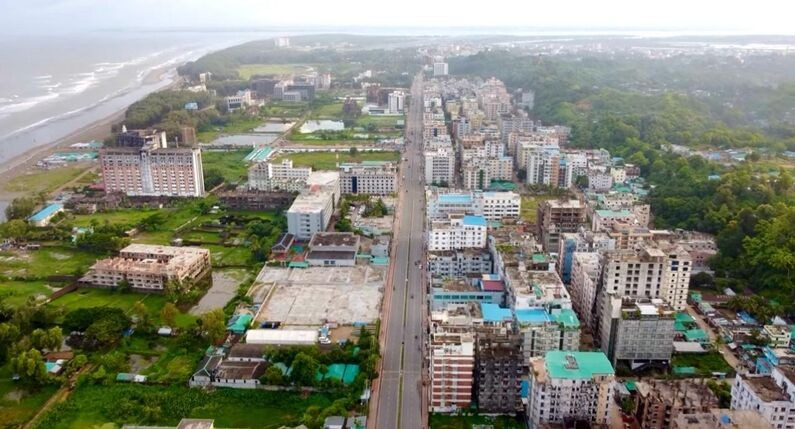
While students often learn that Cox’s Bazar was named after “Cox Sahib’s Bazaar,” history reveals that this coastal city’s original name was Penoa, meaning “yellow flower.”
The story of Cox’s Bazar is as enchanting as it is rich. Another ancient name for the region was Palanki. The transition from Palanki to today’s Cox’s Bazar tells a tale that dates back centuries. Before the Mughal conquest in 1616, the area, including present-day Cox’s Bazar and parts of Chattogram, was under the Arakan kingdom.
The region’s natural beauty captivated Mughal Emperor Shah Shuja during his journey to Arakan via the hilly routes. He ordered the establishment of a temporary fort here. His entourage of nearly a thousand palanquins rested at a place now known as Dulahazara, which translates to “a thousand palanquins.”
After the Mughals, the region saw the influence of the Tripura Kingdom, Arakanese, Portuguese, and British. Cox’s Bazar is named after Captain Hiram Cox, a British East India Company officer.
During Governor Warren Hastings’ tenure, the 1773 Bengal Regulation Act appointed Captain Cox as Superintendent of Palanki.
Tasked with resolving long-standing conflicts between the Arakanese refugees and the local Rakhine population, he made significant progress. Unfortunately, he passed away in 1799 before completing his mission. In recognition of his rehabilitation efforts, we established a market named Cox Sahib’s Bazaar, which later evolved into Cox’s Bazar.
Cox’s Bazar Police Station was formed in 1854, and the municipality was established in 1869.
Spanning 2,491.86 square kilometers (962.11 square miles), Cox’s Bazar is 152 kilometers south of the divisional city Chattogram. Its administrative subdivisions include Cox’s Bazar Sadar, Ukhiya, Kutubdia, Chakaria, Teknaf, Moheshkhali, Ramu, and Pekua.
By Mohammad Morshed
Photo: Collected