
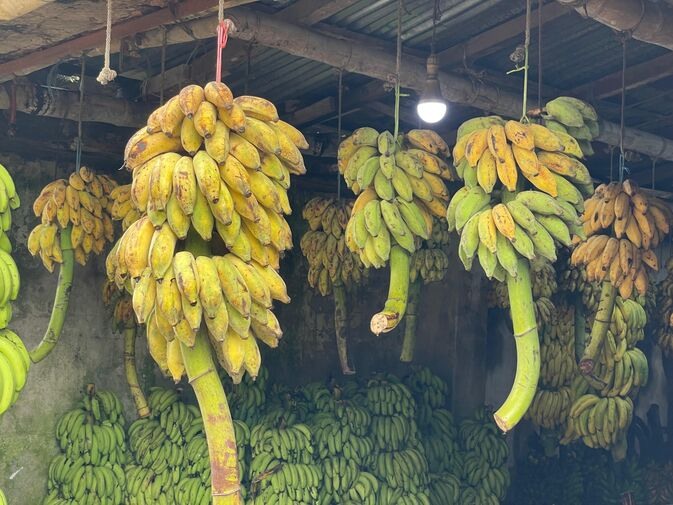
Before dawn breaks, activity begins to build at Kasturaghat in Cox’s Bazar town. One truck after another pulls up in front of the market, carrying bunches of bananas from different parts of the country.
Workers unload the fruit while others arrange the bananas for buyers. In rows of shops, wholesalers and buyers bargain over prices.
From here, traders from different parts of the town, along with vendors who sell bananas from vans, buy the fruit at wholesale prices and take it to markets and neighbourhoods across Cox’s Bazar.
Kasturaghat is the town’s only wholesale banana market. Around 22 banana shops have grown side by side, creating a daily buzz.
The market plays an important role in supplying bananas to the hotel-motel zone, retail shops and mobile vendors across the town.
Traders said bananas arrive at the market from different parts of Bangladesh, particularly the Chattogram Hill Tracts and southern districts.
Traders bring the fruit by truck from distant areas, unload it at Kasturaghat, and then distribute it across Cox’s Bazar through wholesale sales.
Mohammad Arman, a market trader, said Bangla and Champa bananas arrive from Bandarban, while Sagarkola comes from Rangpur.
“After bananas from different areas are unloaded at the Kasturaghat market, they are distributed from here to different parts of the town,” he said.
The market is not only a place to buy and sell bananas. Its activities also support transport workers, labourers and van drivers.
Unloading bananas from trucks, arranging them at shops, sorting them according to buyers’ preferences and transporting them keeps the area busy throughout the day.
The rush intensifies after the trucks arrive in the morning. Wholesalers buy bananas according to their needs.
Some purchase them for retail shops, some for hotels and motels, while others load them onto vans to sell in different neighbourhoods.
Traders said banana prices are currently relatively stable, though prices vary by variety and size.
Shopkeeper Mohammad Ullah said Sagarkola currently sells for around Tk 5–6 a piece, while Bangla bananas cost around Tk 6–8 depending on size. Champa bananas are priced at around the same level, he said.
According to traders, prices depend largely on supply. Prices rise when supply falls or transportation costs increase, while higher supply can bring prices down.
Within a few hours of being unloaded from trucks at Kasturaghat, the bananas make their way to different parts of Cox’s Bazar. Some go to retail shops, some to the hotel-motel zone, and others are loaded onto vans.
From there, they reach neighbourhood streets and eventually the dining tables of households across the town.
In this way, Kasturaghat has become an important centre of Cox’s Bazar’s banana supply network. Bananas brought by truck from the hill districts and distant southern parts of the country are gathered here before being distributed throughout the town.
With around 22 shops lined up side by side, truckloads of bananas, busy workers, and buyers bargaining over prices, the Kasturaghat wholesale market offers a small but lively glimpse into the everyday economic life of Cox’s Bazar.
By Abdur Rashid Manik
Photo: By Abdur Rashid Manik