
Swiss architect, researcher and photographer Niklaus Graber said on Tuesday that Muzharul Islam’s architectural work remains globally relevant for how it integrates buildings with people, nature and the surrounding environment.
“More than simply designing buildings, Muzharul Islam connected them with their surroundings through verandas, open terraces, stepped spaces and links with the natural environment,” Graber said.
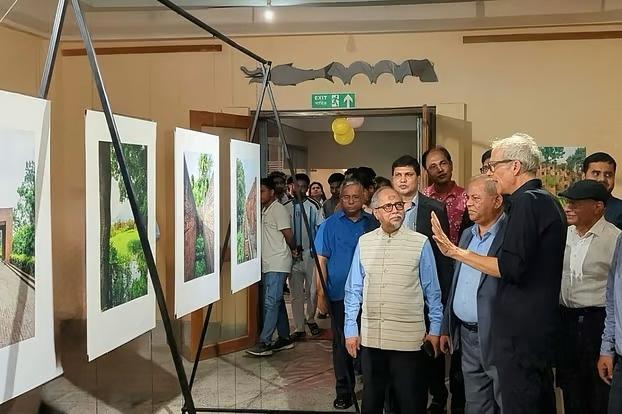
He made the remarks at the opening of a photography exhibition on Muzharul Islam’s works at the Chattogram University Museum.
Titled Spaces of Belonging, the exhibition features 24 photographs by Graber documenting 10 significant projects by Muzharul Islam.
It will remain open for seven days, organisers say.
The venue is particularly significant because Muzharul Islam designed several buildings on the University of Chittagong campus, where the surrounding hills and natural slopes are closely integrated with the architecture.
Graber said Muzharul Islam’s work was rooted in a particular time and place, but many of the ideas reflected in his architecture had universal relevance.
“His work raises questions about how modern architecture can learn from history and how buildings can relate meaningfully to their surroundings,” he said.
Graber has researched Muzharul Islam’s work for nearly a decade, examining drawings, designs and documents from the architect’s collection. He selected 10 buildings representing the early, middle and later stages of Muzharul Islam’s career and photographed them during repeated visits to Bangladesh.
He said several concerns now central to architectural discussions, including environmental sustainability, natural airflow and human needs, were already evident in buildings designed by Muzharul Islam decades ago.
According to Graber, Muzharul Islam combined local and global architectural ideas, adapting elements such as pavilions and verandas from traditional architecture for modern use. He also designed buildings with scope for future changes and rearrangement, which Graber described as “enabling structures”.
Graber also highlighted Muzharul Islam’s emphasis on preserving space for nature, birds and water bodies rather than covering areas entirely with roads and concrete. He said some of his planning ideas could be seen as an early indication of concepts now associated with “sponge city” and nature-based urban planning.
The University of Chittagong campus, he said, was perhaps the closest example of this approach, as Muzharul Islam positioned buildings according to the slopes and contours of the hills to minimise unnecessary landscape alteration.
Pro-vice-chancellor (academic) Professor Mohammad Al Amin, speaking as a special guest, said Muzharul Islam’s contribution was a matter of pride and called for further research on the university’s architectural heritage.
Vice-chancellor Professor Mohammad Al-Forkan said older structures, including the Mozammel Haque Auditorium, Alaol Hall and Shahjalal Hall, were symbols of pride for the university. He said the university was taking steps to make the structures usable again.
Professor Zahidur Rahman, director of the museum, said Graber had made a significant contribution to rediscovering Muzharul Islam’s work.
Pro-vice-chancellor (administration) Professor Md Shafiqul Islam and AK Khan Foundation trustees AK Shamsuddin Khan and AM Ziauddin Khan, among others, attended the event.
Cox’s Bazar Life Report