

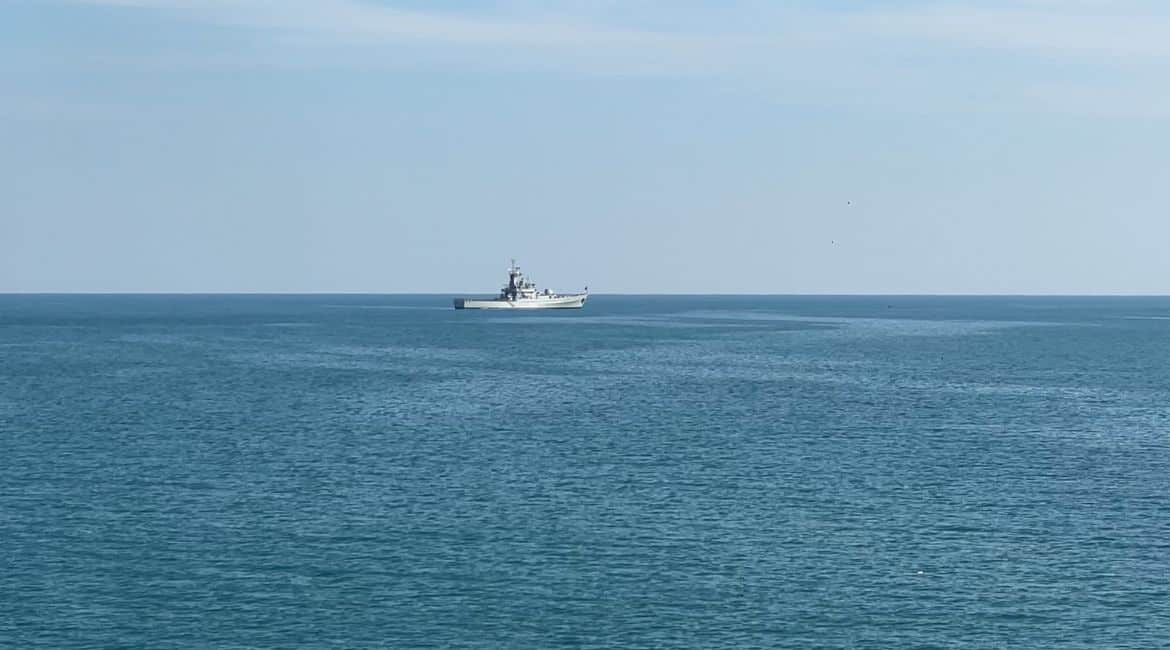
The Bangladesh Navy remains on the highest level of alert round the clock to safeguard the country’s vast maritime territory, including the coral-rich St Martin’s Island.
With modern warships deployed in the deep sea and advanced surveillance technology in operation, the force is playing an effective role in suppressing piracy, ensuring the security of maritime trade and protecting marine natural resources.
Despite recent rumours circulating about the alleged occupation of St Martin’s Island or the intrusion of foreign vessels, the situation on the ground presents a different picture.
A visit to the area shows a strong presence of the Navy and the Coast Guard around the island. State-of-the-art radar systems continuously monitor the island and its surrounding waters.
One of the most prominent symbols of the Navy’s strong offshore presence is the advanced warship BNS Khalid Bin Walid.
Equipped with tri-dimensional capabilities, the vessel is able to provide simultaneous defence in the air, on the surface and underwater.
The ship carries missiles capable of destroying aerial targets up to 180 kilometres away, torpedoes with a range of more than seven kilometres to strike underwater targets including submarines, and systems capable of hitting land-based targets from the sea at distances of up to 15 kilometres.
The ship’s gunnery officer, Lieutenant Commander Kazi Mostafizur Rahman, said that its powerful radar system can detect any aircraft, fighter jet, helicopter or drone once it enters a designated range.
After detection, information is automatically relayed to the gunnery system, enabling firing as required.
The FM-901 surface-to-air missile system, which has eight launchers at the rear of the ship, further enhances its capability to counter aerial threats.
This active and armed naval presence is ensuring Bangladesh’s maritime security and reinforcing the country’s standing in international waters.
The ship’s commanding officer, Captain Arif Rahman, said that fencing off the sea is impossible, making a visible and effective presence the most powerful deterrent.
He added that the vessel represents Bangladesh in international waters while ensuring safe passage for both global and local maritime partners.
Military-grade high-technology helicopters have also reinforced the naval fleet.
These aircraft facilitate swift surveillance, the identification of piracy and illegal activities, and the secure retrieval of local fishing vessels.
Lieutenant Commander Shafikul Islam, a pilot with naval aviation, said that helicopters allow large areas to be monitored within a short time and that any suspicious activity can be immediately reported to nearby ships.
Bangladesh’s maritime area, covering around 119,000 square kilometres, is almost equal to the country’s landmass.
The responsibility of protecting this vast sea territory and its natural resources rests with the Navy. Working in coordination with civilian institutions, the force is also supporting research activities in the maritime domain.
Continuous vigilance by the Navy is helping to secure the country’s marine resources, which, if utilised properly, can make a significant contribution to the national economy.
By Abdu Rashid Manik
Photo: Abdu Rashid Manik