
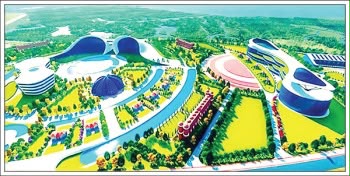
A decade after work began on Sabrang Tourism Park in Teknaf, Bangladesh’s first tourism-focused economic zone, infrastructure is only 10–15 per cent complete, while coastal erosion has claimed much of the land.
The park was planned on around 967 acres in Sabrang union, at the southern end of the 85-kilometre Marine Drive, to attract foreign tourists, raise Cox’s Bazar’s tourism to international standards and create local jobs.
Land development and earth-filling have progressed, but internal roads, drainage, water supply, electricity and other utilities are incomplete, so most investors with land allocations have yet to begin permanent construction.
The Bangladesh Economic Zones Authority (BEZA) began developing the project in 2016; responsibility later passed to Invest Bangladesh. Plans include five-star hotels, resorts, cottages, eco-tourism facilities, a marine aquarium, sea cruises, restaurants and entertainment centres, plus areas for foreign tourists and Saint Martin’s trips.
According to Invest Bangladesh, 28 companies have proposed investments totalling $377.71 million. Leases have been signed with 23, while five await agreements.
So far, 111.49 acres have been allocated to Dutch, Singaporean and Bangladeshi investors for hotels, resorts, cottages, restaurants and other facilities. Stakeholders say a tourism zone cannot operate by allocating land alone; investors need secure land, roads, electricity, water, sewage and drainage.
Nearly half the land lost to erosion
After recently visiting the park, Prime Minister’s Principal Secretary ABM Abdus Sattar said only around 500 of the nearly 1,000 acres originally earmarked remained, as much of the land was lost to the sea because necessary measures were not taken in time. He said a world-class tourism destination was planned on the remaining land. The project’s future depends as much on protecting that land as on attracting investment.
Authorities consider a permanent protective embankment the most urgent task. The Prime Minister’s Office is processing a Development Project Proposal (DPP) for the park’s infrastructure. Officials said construction could take around three years once approved, with separate phased projects to follow for other infrastructure.
Invest Bangladesh member Nahian Rahman Rochi told the media that the embankment was the immediate priority.
“A DPP has been submitted for this. At the same time, work is underway to revise the master plan, keeping sustainability and environmental considerations in mind,” he said.
Stressing inter-agency coordination, he also said that if cooperation from all concerned parties continues, they hope the project can become operational within the next five to 10 years.
Teknaf Upazila Nirbahi Officer SM Anik Chowdhury told Cox’s Bazar Life that the park was primarily under Invest Bangladesh and the Principal Secretary had given necessary instructions.
“The Water Development Board has been asked to prepare a DPP regarding the areas of the project that are facing erosion. A decision may come after a meeting at the higher level,” he added.
The proposed jetty was expected to be completed within around two years, he said, though overall implementation depended on Invest Bangladesh. As far as he had heard, the entire area had been filled, and fencing was underway.
Locals want faster action
Many locals are frustrated after years of hearing about the project without seeing significant job opportunities.
Abdul Mannan, acting chairman of Sabrang Union Parishad, said a large area was earlier lost to erosion, but erosion has not been significant since the embankment was built, though it needs further repair.
“Everyone keeps saying it will happen, it will happen, but the work is not progressing. We will understand that it will happen when the work actually begins,” he said.
He also said they want the work completed as quickly as possible. If possible, within five or six months. But they have said it will take another two to three years.
“The sooner the work is completed, the better it will be for the local people and for us,” he added, saying it would create jobs and livelihoods.
Why progress has been slow
Eight to 10 investors have expressed interest in starting operations in temporary structures within the next one to two years, but officials said government infrastructure is needed before permanent hotels and resorts can be built.
Officials and investors cite land acquisition and development complications, the Covid-19 pandemic, inadequate funding, infrastructure delays and coastal erosion; the land loss has also forced a rethink of long-term planning. Allocating land alone has not been enough; protecting the remaining land, transport infrastructure and utilities must progress alongside investment.
By Abdu Rashid Manik
Photo: Collected