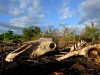


Moheshkhali Island in Cox’s Bazar is one of Bangladesh’s major salt-producing hubs. Every year, as the dry season sets in, thousands of farmers become busy producing salt using the polythene method across thousands of acres of land.
Although the target for the current season runs into several hundred thousand tonnes of crude salt, farmers are gripped by anxiety due to dense fog, untimely rainfall, and, most critically, the absence of fair market prices.
According to local sources, salt cultivation is currently at its peak in the unions of Matarbari, Dhalghata, Kalarmarchhara, Boro Moheshkhali, Hoanak, Shaplapur, and Kutubjom. Farmers are working from dawn to dusk in the salt fields, yet many fear losses as prices remain well below expectations.
Ariful Islam, a salt farmer from Dhalghata union, said, “My family has been involved in salt farming since before I was born. But this year, the price of salt has fallen drastically. We cannot even recover production costs, and paying workers’ wages has become extremely difficult.”
Farmers said that unpredictable weather conditions pose a constant risk of damage to salt fields, and low market prices could push them into severe financial distress. Their concerns deepened recently after a decision to import salt, which triggered protests among salt farmers nationwide. They feared that imports would further depress the prices of locally produced salt.
Following strong protests from farmers, the government later withdrew its decision to import salt, bringing some relief. However, the lack of guaranteed fair prices continues to cause uncertainty.
Farmers are now demanding that the government fix a minimum support price for salt, expand storage facilities, and provide assistance to mitigate weather-related risks.
They argue that such measures are essential to protect the livelihoods of the hundreds of thousands of people dependent on the salt sector.
By Abdu Rashid Manik
Photo: Abdu Rashid Manik