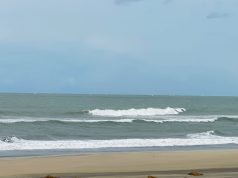

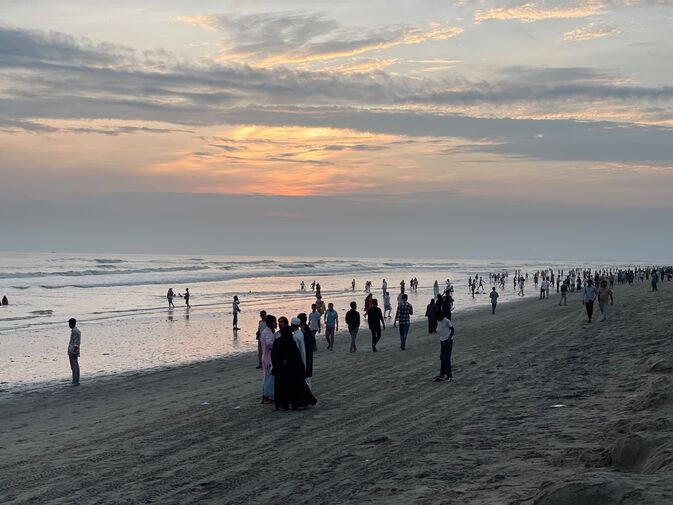
The long-awaited sunset returned to Cox’s Bazar on Monday after nine consecutive days of rain and gloomy weather, drawing thousands of tourists and locals to the world’s longest natural sea beach.
The district had remained under persistent heavy rainfall since July 4, preventing visitors from witnessing its iconic sunset. Although light rain fell briefly on Sunday, the weather cleared later in the day and remained largely dry through Monday, allowing the sun to reappear over the Bay of Bengal.
From late afternoon, large crowds gathered at the Kolatoli, Sugandha and Laboni beach points to watch the sunset. Visitors strolled along the shore, relaxed under beach umbrellas and captured photos and videos as the crimson sun slowly dipped below the horizon, restoring a festive atmosphere to the beach after days of severe weather.
“I had almost given up hope of seeing the sunset,” said Mehdi Hasan, a tourist from Dhaka. “We experienced nothing but rain for several days after arriving in Cox’s Bazar. Watching today’s sunset was truly worth the wait.”
Another tourist, Sabiha Rahman from Chattogram, described the view as unforgettable. “Seeing the sun disappear into the sea was breathtaking. We’ve taken plenty of photos and videos to remember the moment,” she said.
Local resident Zahidul Islam said the beach had remained largely deserted during the prolonged spell of rain and flooding. “Today the crowds have returned. It is a welcome sight for everyone,” he said.
Despite the improved weather, authorities have urged tourists to remain cautious. Red warning flags are still flying along the beach, indicating that sea conditions remain unsafe for swimming. Lifeguards continue to patrol the designated bathing areas at Kolatoli, Sugandha and Laboni.
Senior lifeguard Rashid Ahmed said visitor numbers had increased significantly since the rain stopped. “We have been on duty throughout the day, advising tourists to follow safety instructions and avoid risky areas,” he said.
Assistant Meteorologist Abdul Hannan of the Cox’s Bazar Meteorological Office said only 4 millimetres of rainfall had been recorded in the 24 hours until 3:00pm on Monday, compared with 47 millimetres during the previous 24-hour period.
“There is no indication of another prolonged spell of heavy rain for now,” he said. “Some rainfall is possible on Thursday or Friday, but it is unlikely to continue for several consecutive days.”
According to a district administration flood situation report, Cox’s Bazar normally receives around 924 millimetres of rainfall throughout July. However, 823 millimetres fell between July 4 and July 12 alone, triggering widespread flooding across the district.
Although large parts of Cox’s Bazar were inundated after more than a week of torrential rain, floodwaters have started to recede over the past two days as rainfall eased. The gradual improvement in weather has also revived tourism, with Monday’s sunset offering a symbolic return to normalcy for both visitors and local businesses.
By Abdur Rashid Manik
Photo: Abdur Rashid Manik