
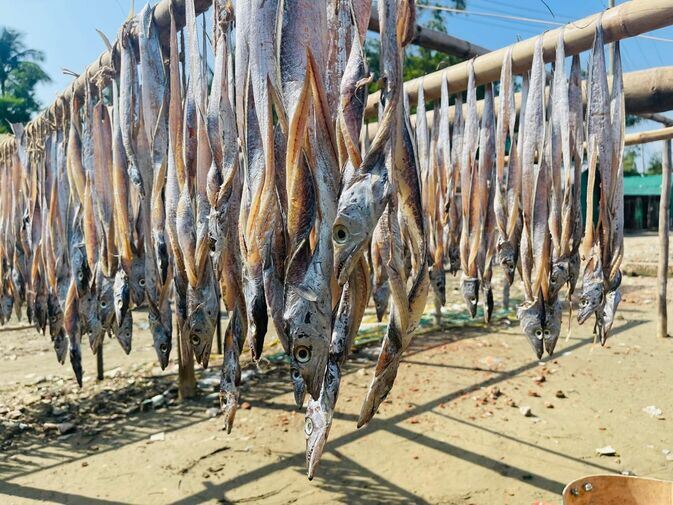
Cox’s Bazar, Bangladesh’s dry fish production hub, once played a vital role in the international market. However, it now faces significant challenges in competing with countries like Ecuador, Myanmar, Thailand, India, and Vietnam. Despite being a key dry fish production center, Cox’s Bazar is witnessing a surge in foreign dry fish imports, indicating gaps in its market presence.
Production and Export Scenario
Bangladesh annually produces around 600,000 tons of fresh marine fish, primarily meeting domestic demand. Only 20% is preserved as dry fish. Export earnings from dry fish hover around USD 2.5 million annually, significantly lower than its potential.
Challenges in Competing Internationally
Myanmar’s dry fish dominates the international market due to its lower cost. In comparison, the dry fish from Cox’s Bazar struggles to balance quality and price competitiveness.
Overfishing, environmental pollution, and climate change have significantly reduced fish availability in Cox’s Bazar, leading to higher production costs.
Outdated Techniques: Most dry fish production in Cox’s Bazar relies on traditional methods, while competitors like Thailand and Myanmar utilize advanced technologies, ensuring better quality and market appeal.
Lack of Government Support
The dry fish export industry remains underdeveloped due to insufficient government initiatives. Exporters face challenges in accessing advanced technology, training, and financial support. Additionally, the absence of stringent quality control measures limits the recognition of Bangladeshi dry fish in global markets.
Steps Towards Improvement
The following measures are essential to revive Cox’s Bazar’s international dry fish market position.
To regulate overfishing strict controls should be taken on overfishing and protecting breeding seasons to ensure sustainable fish supplies.
Moreover, it is essential to encourage the use of modern fish dryers and scientific processing methods to produce hygienic, high-quality dry fish.
The government should implement policies that provide exporters with financial incentives, technical training, and access to global markets.
Authority should establish rigorous quality control systems to meet international standards and gain buyer confidence.
Moreover, promoting Bangladeshi dry fish through trade fairs and exploring untapped international markets is necessary.
Expert Opinions
Scientists from BCSIR (Bangladesh Council of Scientific and Industrial Research) emphasize that adopting fish dryer technology could position Bangladesh among the top dry fish exporters, alongside Vietnam, Ecuador, and India.
The dry fish industry of Cox’s Bazar holds immense potential, not just for local economic development but also for boosting the country’s export earnings. Improving quality, adopting innovation, and implementing robust policies are crucial to compete globally. With the right strategies, the dry fish industry could again bring Bangladesh to prominence in the global market.
By Rajin Saleh
File Photo