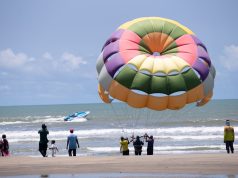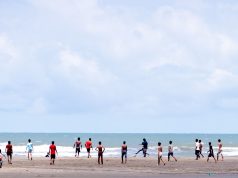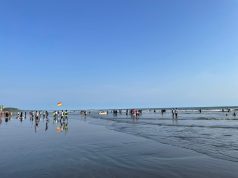

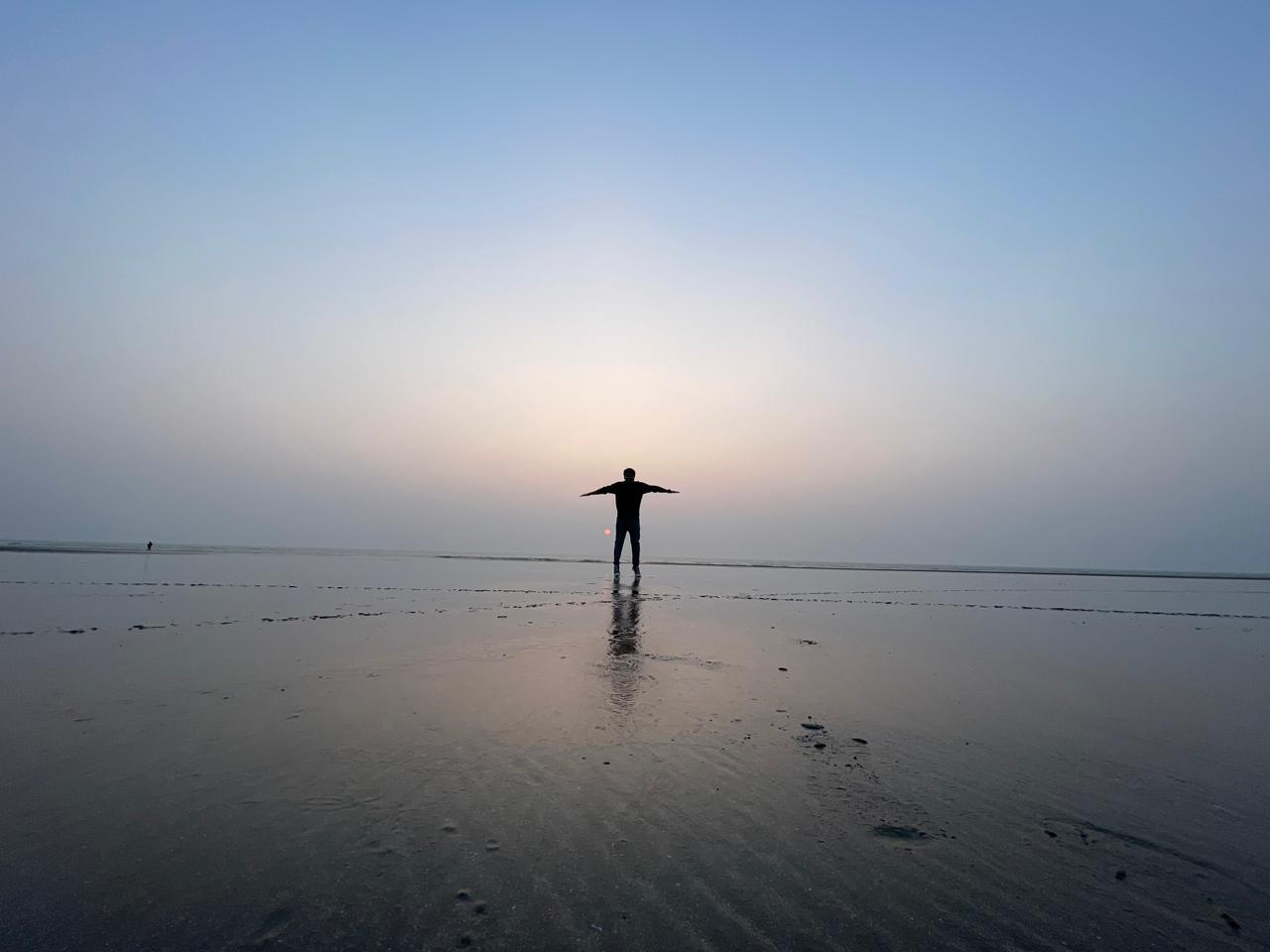
Masum Billah, who came to Cox’s Bazar from Dhaka’s Nilkhet with his newlywed wife and family, stood gazing at the endless sea at Laboni Point. When asked how he felt about Cox’s Bazar, he replied with a sigh, “There’s nothing here except the sea. It’s just sea, sea, and sea—24 hours a day. We’ve spent one night by the beach, but for the next night, there’s nothing else to do. There’s no arrangement for nighttime entertainment.”
Expressing his disappointment, Masum added, “The entire tourism area of Cox’s Bazar seems to have developed without any proper plan. Makeshift shops and street vendors are everywhere, making it difficult to even walk along the beach. Rows of beach umbrellas have occupied large areas, blocking tourists from moving freely. And the endless shouting of hawkers—it’s exhausting.”

His wife, Souravi Chowdhury, echoed the frustration. “Every day, thousands of people visit the beach. Most of them go swimming, but there’s no proper changing room or shower facility. A few shabby, unhygienic huts have been set up by locals, but they’re so dirty that you wouldn’t want to step inside,” she said. She also pointed out the lack of breastfeeding corners and inadequate safety measures for women.
The couple further complained about excessive costs. “There’s no control over fares here—whether it’s transport or hotel rent. The amount we spend here could easily cover a foreign trip,” Masum noted.

Hasem Ali, a businessman from Dhaka’s Sutrapur, said that after dark, the three main beach points—Sugandha, Laboni, and Kolatoli—become risky to visit. “Even parts of the hotel-motel zone feel unsafe at night. The area is so overcrowded that it’s no better than Dhaka. Cox’s Bazar has a 120-kilometer-long beach—so why are all the hotels packed into just two or three kilometers?” he asked.
Nasima Khatun, a tourist from Bogura, compared Cox’s Bazar to Thailand. “In Thailand, there are clean, well-maintained walking lanes and sitting areas along the sea. Here, you find none of that. The Marine Drive could have been a great attraction, but it’s far and inaccessible at night,” she said.

A visit to the three major beach points—Kolatoli, Sugandha, and Laboni—revealed an overwhelming number of illegal makeshift shops and structures. Despite a High Court order for their removal, illegal establishments continue to sprout along the beach.
Speaking to Cox’s Bazar Life, Abu Morshed Chowdhury Khoka, President of the Cox’s Bazar Chamber of Commerce and Cox’s Bazar Civil Society, said, “We call Cox’s Bazar the gateway to tourism, but that’s just lip service. The government earns huge revenue from here, yet we’ve failed to explore the full potential beyond the beach. We have immense scope for cultural, river-based, religious, eco, coastal, and community-based tourism—but there’s a lack of sincerity.”
“No tourist-friendly environment has been developed yet. The government should take the initiative to create one, which will also attract foreign investors. Investors—both local and international—want assurance of security for their investments,” he added.
When asked why foreign tourists rarely visit Cox’s Bazar, Khoka explained, “Why would they come? We don’t offer any attractive tourism packages. Countries like Sri Lanka and the Maldives attract millions of visitors daily with tailored travel packages. We need trained tour operators, easier visa processing, and on-arrival visa facilities at the airport. Most importantly, from rickshaw-pullers to administration officials—everyone must adopt a tourist-friendly mindset.”

Md. Tanvir Hasan, Assistant Urban Planner of the Cox’s Bazar Development Authority, said that according to the 2013 master plan, no construction is permitted within 300 meters of the municipal area and 500 meters along the Marine Drive.
“Regular drives are being conducted to remove illegal structures. A new master plan is also being prepared and is expected to be completed by June next year,” he added.
Hasan personally believes that the unplanned growth of structures can only be controlled through coordinated action among the Environment Department, District Administration, and Municipality.
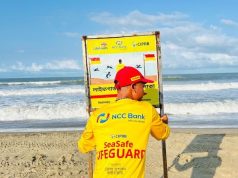
Meanwhile, Additional DIG Appel Mahmud, chief of Cox’s Bazar Tourist Police, told Cox’s Bazar Life, “Tourists can now move safely across the beach, day and night. Our teams are always ready to ensure the safety of tourists. In the event of an emergency, tourists can call 01320 160000 for immediate assistance. Tourist Police boxes are also stationed across major points.”
This Saturday, September 27, the world observes World Tourism Day, with the theme “Tourism and Sustainable Transformation.” The day aims to raise awareness of the vital role of tourism in promoting social, cultural, political, and economic development worldwide.120-kilometre-long
By Abdu Rashid Manik
Photo: Abdu Rashid Manik