
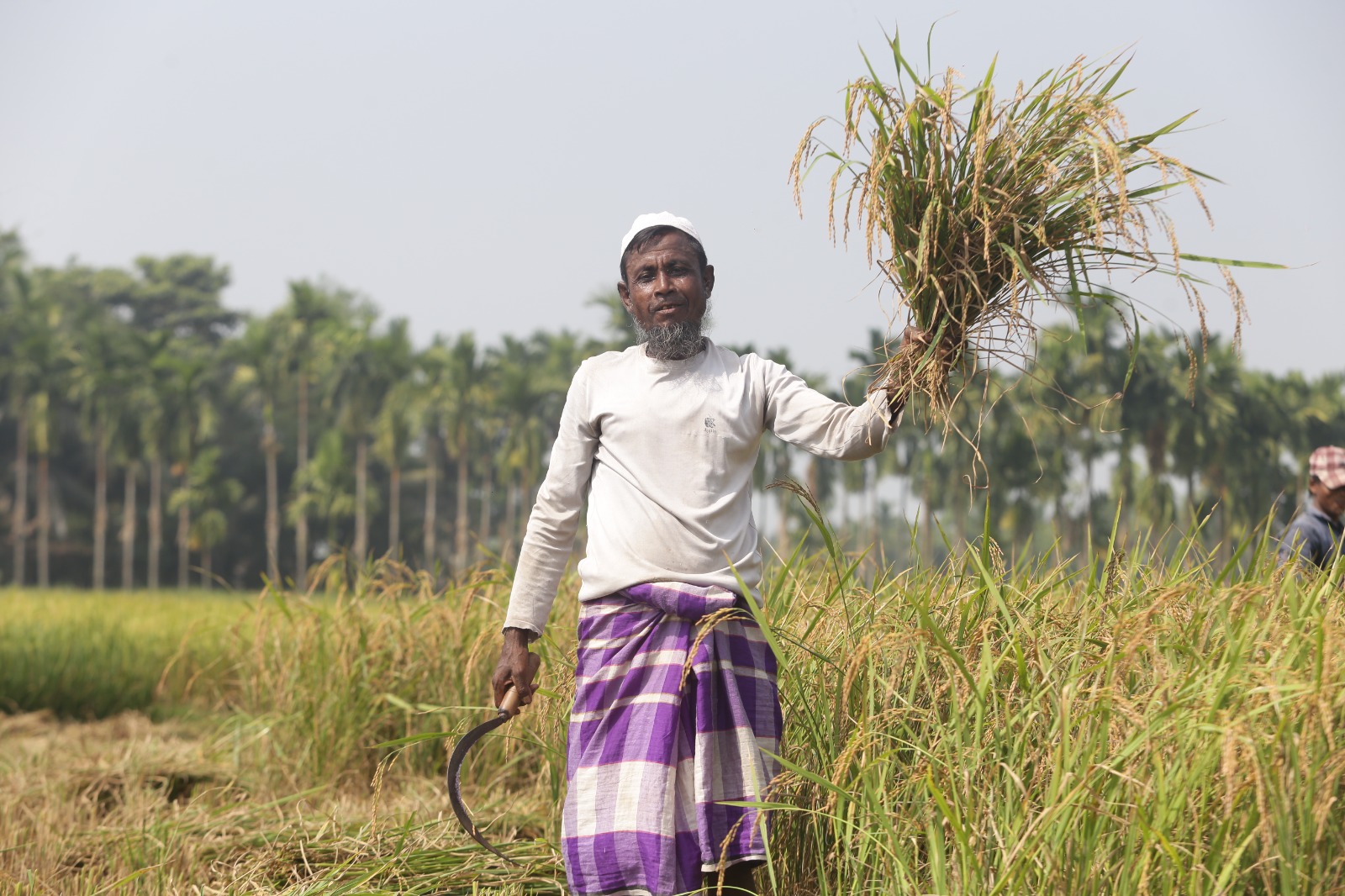
The courtyards of farmers are now filled with the fresh aroma of newly harvested Aman paddy as the harvest season peaks across Cox’s Bazar. Farmers are passing busy days cutting, threshing, and storing rice for Nabanna, the traditional harvest festival. With both excellent yield and a favorable market, smiles have returned to farmers’ faces. The Department of Agricultural Extension (DAE) in Cox’s Bazar reports that farmers have already harvested 70–80 percent of Aman fields.
Officials say timely rainfall and the absence of natural calamities have contributed to a strong yield this season. Although production costs were relatively high, they believe it will not significantly affect overall output. Accurate production figures will be available once the harvest is fully completed.
In the 2025–26 fiscal year, the Aman cultivation target in Cox’s Bazar district was set at 78,730 hectares across nine upazilas. Of this, Chakaria accounted for 19,550 hectares (hybrid and Ufshi varieties), Pekua 8,435 hectares, Ramu 9,450 hectares, Sadar 4,445 hectares, Eidgaon 4,145 hectares, Ukhiya 9,690 hectares, Teknaf 10,935 hectares, Maheshkhali 8,100 hectares, and Kutubdia 3,980 hectares.
Around 8–10 high-yielding rice varieties are commonly grown in Cox’s Bazar, including BRRI Dhan-28, 29, 49, 89, 103, and 75. These varieties typically yield 25–28 maunds per bigha, prompting farmers to cultivate them more widely this season.
A field visit found farmers working continuously from morning until dusk—cutting, threshing, transporting, and storing their precious golden paddy. Cool winter breezes sway the ripe fields, shimmering gold as far as the eye can see. Women farmers are equally contributing to this grand seasonal effort.
Farmers say they faced little irrigation trouble this year as rainfall arrived just on time, helping ensure a bountiful yield. They expect to make a decent profit from rice sales. For them, this is a time of celebration—their very own “Aman Festival.”
Daily wage harvesters in Ramu’s Chakmarkul area told this correspondent that they join the harvest every year. One of them, Badsha, said they are paid Tk 800 per day, including two meals.
Abul Kashem, a farmer from Khurushkul, said, “A bigha of land produces around 7–8 maunds of Aman on average, but yields vary depending on the variety. Hybrid varieties are more profitable here.”
In the Choufaldandi union, farmer Mohammad Rahim Uddin cultivated BRRI Dhan-28 on his two bighas. With harvesting nearly complete, he hopes to get 20–25 maunds of paddy this season.
Dr. Bimal Kumar Promanik, Deputy Director of the DAE in Cox’s Bazar, said, “Compared to last year, Aman yields are much better this season. About 70 percent has already been harvested, with the remaining expected to be completed within a few days. We are hopeful the target will be exceeded.”
Meanwhile, the government has set procurement prices for Aman rice in the 2025–26 fiscal year—Tk 34 per kg for paddy, Tk 50 for parboiled rice, and Tk 49 for atap rice. The district is expected to produce 167,471 metric tonnes of rice this season.
Nationwide, Aman cultivation covered 5.7 million hectares, with a production target of 17.8 million metric tonnes.
By Abdu Rashid Manik
Photo: Hussain Shetu