

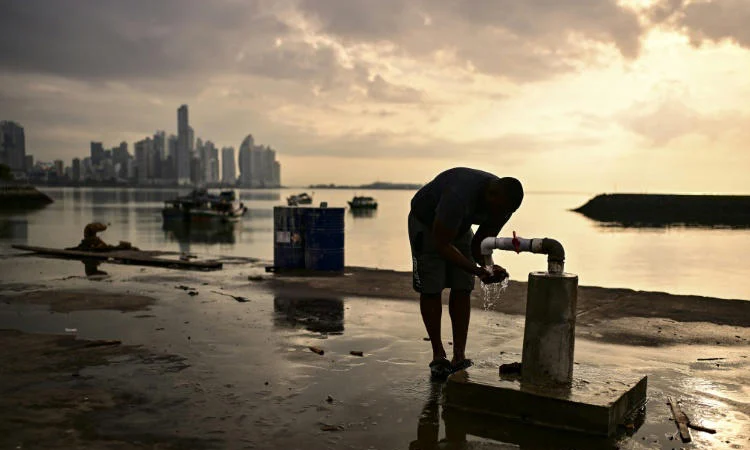
Fishermen along Latin America’s Pacific coast are reeling in half-empty nets as ocean warming aggravated by El Nino causes tuna, anchovies and other top catches to migrate to cooler waters.
From Ecuador and Peru in South America, to Panama and Guatemala in Central America, some skippers have stopped going out altogether as fish stocks dwindle close to shore, in seas running at up to six degrees Celsius above normal.
“The water is warm,” Juan Ollague, 56, told AFP in the southwestern Ecuadoran port of Santa Rosa where hundreds of idle fishing boats are crammed into a small port.
After a night on the water, Ollague returns with just six small tuna.
“We came away empty-handed,” he lamented.
“Fishing used to be good, now it’s terrible,” fellow skipper Darwin Zambrano, 53, complained as he untangled a net that hasn’t scooped up big tuna like albacore or bonito in weeks.
El Nino is the warming phase of a natural cycle in the tropical Pacific that causes hotter and drier conditions in some places, and cooler and wetter in others.
This year’s “super” El Nino, which is expected to peak later this year, is already wreaking havoc in Central America, where drought is endangering animals and stunting crops.
The average sea surface temperature, excluding polar regions, reached 21.07C in August, tying with March 2024 as the hottest on record, according to the European Union’s Copernicus climage change observatory.
The average sea temperatures off Ecuador’s coast rose by 2.5-3C at the surface and up to 6C at a depth of 40 meters in the past ten weeks, said oceanographer Jonathan Cedeno, who led a mission from Guayaquil’s Polytechnic University to measure the temperatures.
Cox’s Bazar Life Desk/BSS