
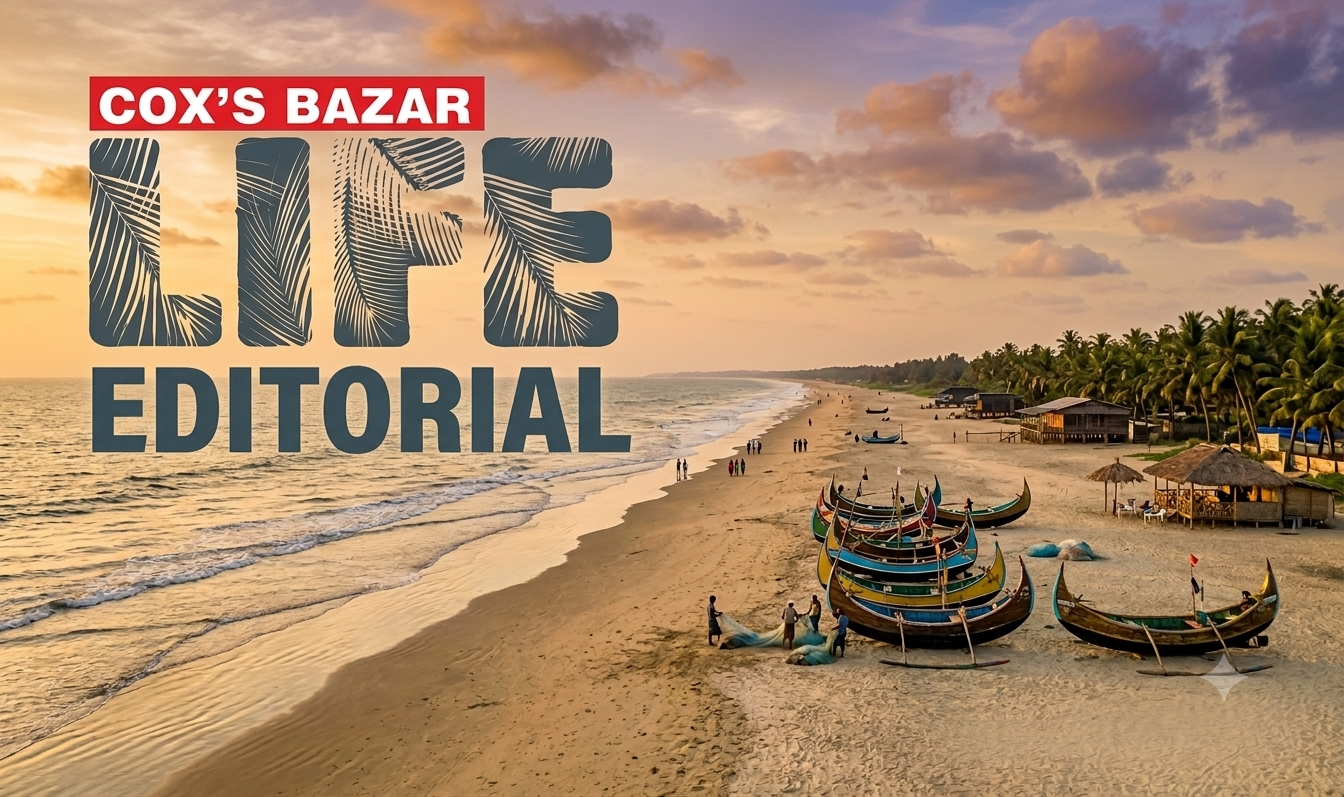
Cox’s Bazar is a major hub of Bangladesh’s blue economy. Tourism, marine fisheries, fuel, salt and shrimp generate enormous economic activity. But behind this visible economy lies another vast sector that works tirelessly every day: the care economy. It consists largely of unpaid care work that continues day and night, yet remains almost invisible in national accounts, public budgets and conventional measures of economic value.
An Oxfam study of Rohingya and host communities in Cox’s Bazar found that women spend about 70 hours a week on care work, compared with just 11 hours for men. Cooking, cleaning, caring for children and the elderly, and meeting the daily needs of families depend heavily on women’s unpaid labour. This work carries no wage, yet it is indispensable to keeping households—and ultimately the wider economy—functioning.
The same imbalance is visible in paid work. Local surveys indicate that nearly 18,000 women work in Cox’s Bazar’s dried-fish yards, washing, cutting, drying and sorting fish. For up to 12 hours of work, they earn only BDT 450–500—about half the earnings of male workers. In tourism, women are also essential to cleaning, laundry and cooking in hotels and restaurants. Yet much of this work remains informal, low-paid and inadequately protected.
According to the Household Production Satellite Account of the Bangladesh Bureau of Statistics (BBS), developed with UN Women, the value of unpaid domestic and care work in Bangladesh in 2021 was equivalent to about 18.9 per cent of GDP under a hybrid valuation method combining direct and indirect approaches. Women performed nearly 85 per cent of this work. Globally, the International Labour Organization (ILO) estimates that unpaid care work is equivalent to about 9 per cent of GDP. These figures make one point clear: the care economy is not peripheral to economic life. It is one of its largely invisible foundations.
On this basis, a preliminary estimate suggests that the economic value of invisible care work in Cox’s Bazar could be in the range of BDT 4,000–5,000 crore. This should not be treated as an official local GDP estimate, but as an indication of the scale of economic value that conventional measures fail to capture.
The failure to recognise this labour deepens inequality, financial insecurity and gaps in social protection, while placing a heavy physical and emotional burden on women. When women carry the double burden of unpaid care and low-paid employment, their economic independence is further constrained.
The way forward is clear: care work needs policy recognition and investment. Bangladesh should expand quality care services for children and older people, strengthen social protection, and ensure fair wages and safe working conditions in the informal sector. Women also need greater access to property, credit, training and decent employment.
Making the care economy visible is not simply about correcting the books. It is about recognising labour, dignity and contribution that have long remained outside the economic spotlight. That recognition, followed by effective policy action, can strengthen household purchasing power, make Cox’s Bazar’s tourism and blue economy more sustainable, and help build a fairer and more resilient local economy.
By Salam Abu
Editor