
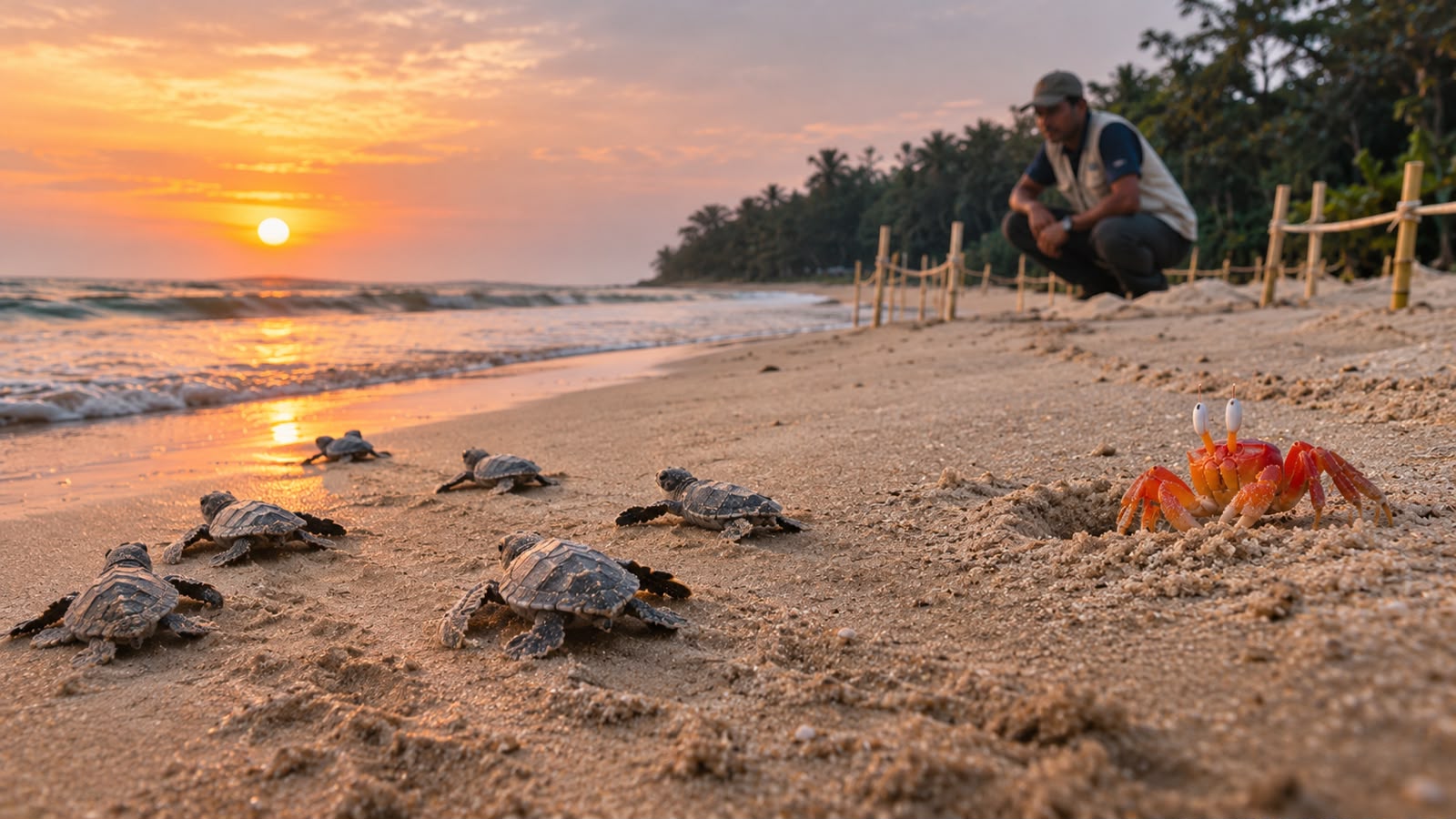
Winter is approaching, and with it comes the sea turtle nesting season along the Cox’s Bazar coast. Under cover of darkness, female Olive Ridley turtles come ashore to lay eggs on beaches around St. Martin’s Island, Sonadia, Inani and Teknaf. By daylight, red ghost crabs scurry between burrows in the sand. Often overlooked by visitors, both are part of the coast’s natural identity.
Olive Ridleys feed on jellyfish, crabs, shrimp and other marine animals, contributing to the ocean’s food web. Ghost crabs help maintain beach ecosystems by digging burrows that allow air to circulate through the sand and help recycle organic matter. Researchers also study burrow density to assess human disturbance on beaches.
Conservation can support livelihoods. In Tortuguero, Costa Rica, and Rekawa, Sri Lanka, regulated turtle-watching tourism has created opportunities for local communities. Tortuguero requires authorised guides for nesting tours. Cox’s Bazar could explore carefully managed nature tourism where scientific assessments show it is safe. Fishermen and young residents could work as guides, conservation workers and research assistants. With proper safeguards, crab habitats might also attract nature enthusiasts. But tourism must never compromise the species it seeks to celebrate.
The threats are serious. Classified globally as vulnerable, Olive Ridleys face fishing-net entanglement, pollution and artificial lighting near nesting beaches. In early 2025, more than 100 dead Olive Ridleys were reported along the Cox’s Bazar coast within weeks, with conservationists pointing to fishing-net entanglement as a possible cause. Motorcycles, horses and heavy foot traffic also disturb ghost crab habitats. If tourism destroys the biodiversity that makes these beaches special, how sustainable can that development be?
There are encouraging signs. Figures reported by conservation organisations NACOM, CODEC and Arannayk Foundation show that Olive Ridley egg collections rose from 7,117 in 2022 to 16,350 in 2023 and 36,962 in 2024. The increase may reflect wider collection efforts, not necessarily a rise in turtle populations. A study in Kuakata found ghost crab burrow density nearly 19 times higher on protected beaches than on unprotected ones. These findings underline the value of protecting habitats.
Cox’s Bazar needs a coordinated coastal biodiversity conservation plan. The Forest Department and local authorities should identify critical nesting and crab habitats, enforce seasonal restrictions on vehicles, excessive lighting and access to sensitive beaches, and reduce harmful fishing practices. Local communities must share in conservation’s economic benefits through training and employment. Visitors have responsibilities too: leave no litter and give wildlife space.
Protecting Olive Ridley turtles and red crabs is more than an environmental obligation. It is a long-term investment in coastal livelihoods, sustainable tourism and the future of Cox’s Bazar’s blue economy.
By Salam Abu
Editor