
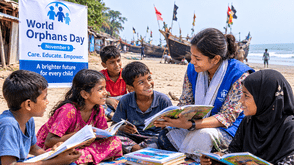
Cox’s Bazar is increasingly looking to tourism, fisheries and the wider blue economy for future growth. Yet one question rarely enters the discussion: where do orphaned and disadvantaged children fit into the region’s future? World Orphans Day, observed on November 9, offers an opportunity to ask.
Islam places particular importance on the welfare of orphans. The Qur’an says, “To improve their condition is best” (Al-Baqarah 2:220). Caring for orphans should mean more than providing charity. It should also mean ensuring education, protection and the opportunity to lead a dignified life. The UN Convention on the Rights of the Child likewise recognises children’s rights to protection, education and development.
In Cox’s Bazar, both local communities and Rohingya settlements include children who have lost parents or lack adequate care. Some leave school under financial pressure; others grow up without reliable support. Their circumstances demand different responses. For Rohingya children, limited access to formal employment makes education, protection and approved skills programmes particularly important.
For local young people, the blue economy could offer a practical route towards independence. Sustainable fisheries, seaweed cultivation, seafood processing, ecotourism, boat-engine repair and digital systems for fish supply chains all offer possibilities for skilled work. The starting point, however, must be schooling, followed by appropriate vocational training as children reach working age.
The economic case is worth considering. Suppose 10,000 disadvantaged young people in Cox’s Bazar eventually secured jobs after training. At an average monthly income of Tk 20,000 each, their combined annual earnings would reach Tk 240 crore.
Turning that possibility into reality requires more than occasional donations or ceremonial corporate social responsibility programmes. The district administration and Department of Social Services should first identify gaps in education, care and support, then work with existing schools and vocational institutes to address them. Building on institutions already in place may prove more effective than creating new ones.
Maritime training programmes could be developed with technical input from the Navy, Coast Guard and relevant institutions, offering eligible young adults skills in navigation, lifesaving and marine safety. Hotels, resorts and tourism businesses could provide paid apprenticeships. All programmes must respect minimum working-age rules and keep children out of hazardous work.
Technology training and small-business support would widen the choices available. A transparent welfare fund, backed by voluntary contributions from tourism businesses and development partners, could help finance education and training.
The success of Cox’s Bazar’s blue economy should not be measured by visitor numbers or marine output alone. It should also be judged by whether children growing up with the least support can look forward to safer, more dignified lives. Their future deserves a place in the region’s development plans.
By Salam Abu
Editor