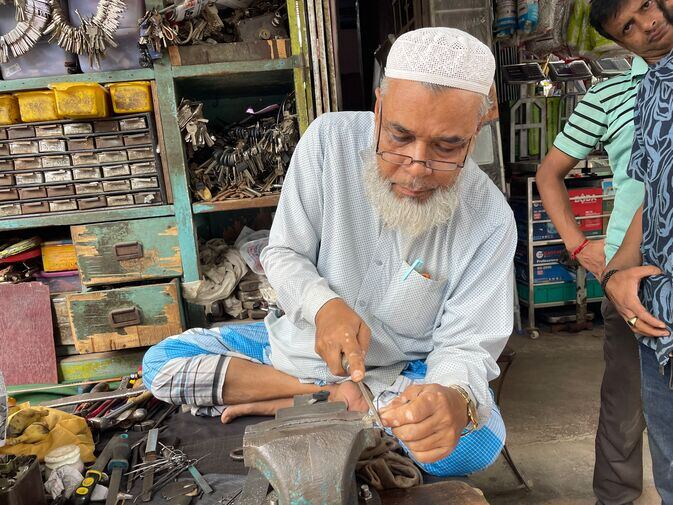
Tucked away on the pavement opposite the municipal market at Bazarghata Mosque Road in Cox’s Bazar stands a tiny locksmith’s shop that most passers-by hardly notice.
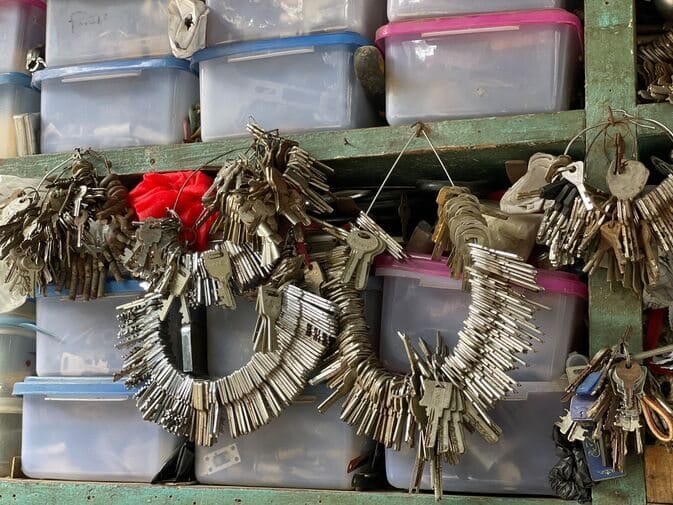
At first glance, it appears no different from any other roadside workshop. But a closer look reveals hundreds of keys neatly hanging from hooks or stacked inside small boxes — old and new, tiny and large, each with its own story. Around them lie files, cutters, blanks and polishing tools collected over decades.
Behind this modest shop is a remarkable history spanning nearly 110 years and four generations of a family whose livelihood has revolved around one simple craft: making keys.
The story began long before Bangladesh gained independence.
About 110 years ago, Makbul Ahmed Contractor established the business, painstakingly crafting keys by hand at a time when every piece had to be measured, filed and shaped individually. He remained devoted to the trade for nearly seven decades, working until the final years of his life.
Around 1980, his son Abdul Quader inherited both the workshop and the craft.
Nearly 46 years later, Abdul Quader still sits at the same roadside shop, producing keys much as his father once did.
“I learnt everything sitting beside my father,” he said while carefully shaping a customer’s key.
“He started this business, and I simply continued it. Since taking over the shop in 1980, I have made keys for countless people. I couldn’t possibly tell you how many.”
In those early days, every duplicate key demanded patience, precision and experience. Locksmiths relied entirely on traditional hand tools, carefully filing each blank until it perfectly matched the original.
Technology has since transformed the trade.
About 15 years ago, Abdul Quader invested in modern key-cutting machines, enabling him to produce keys much faster and with greater accuracy than before.
Yet the old tools remain, along with something even more precious — keys dating back almost to the shop’s earliest days.
For Abdul Quader, they are more than pieces of metal.
“They remind me of my father,” he said.
“Everything else has changed — the machines, the tools, even the types of locks people use. But the essence of our work remains the same: making a key that fits perfectly.”
His customers arrive with all kinds of problems.
Some bring worn-out keys that need to be duplicated. Others arrive carrying only a lock after losing the original key altogether. Years of experience allow Abdul Quader to create new keys even without an existing sample.
The shop also cuts motorcycle and car keys, adapting traditional craftsmanship to modern demands.
On an average day, he produces between 150 and 200 keys. Depending on the type and complexity, prices range from Tk20 to Tk20,000, while his daily earnings fluctuate between Tk500 and Tk5,000.
But the significance of the shop extends far beyond its income.
For generations, it has quietly solved everyday emergencies for the people of Cox’s Bazar — replacing lost house keys, duplicating office keys, unlocking old cabinets or cutting new keys for vehicles.
Standing quietly beside his grandfather is the family’s fourth generation.
Atik Islam Abhi has spent much of his childhood in the shop, gradually learning every aspect of the trade — from operating cutting machines to judging the precise measurements needed to produce a perfect key.
“I’ve learnt everything from my grandfather,” Abhi said.
“I’ve been coming here since I was a child. Now I can do much of the work myself. I want to continue this profession in the future.”
As Abdul Quader approaches retirement, he hopes to pass on not just the business but also the craftsmanship, patience and reputation built over more than a century.
When that happens, the legacy started by Makbul Ahmed Contractor will enter its fourth generation.
The little pavement shop may not have an impressive signboard or an elegant storefront. Yet every key hanging inside carries a fragment of its history. Every worn-out tool bears the marks of decades of labour, while each generation has added another chapter to the family’s remarkable story.
Much has changed in Cox’s Bazar over the past century. Roads have widened, buildings have risen, technology has reshaped everyday life, and new businesses have emerged.
But this tiny locksmith’s shop remains where it has always been — quietly preserving a disappearing craft while reminding the city that some traditions survive not through monuments or museums, but through the steady hands of those who continue them, one key at a time.
By Abdu Rashid Manik
Photo: Abdu Rashid Manik