
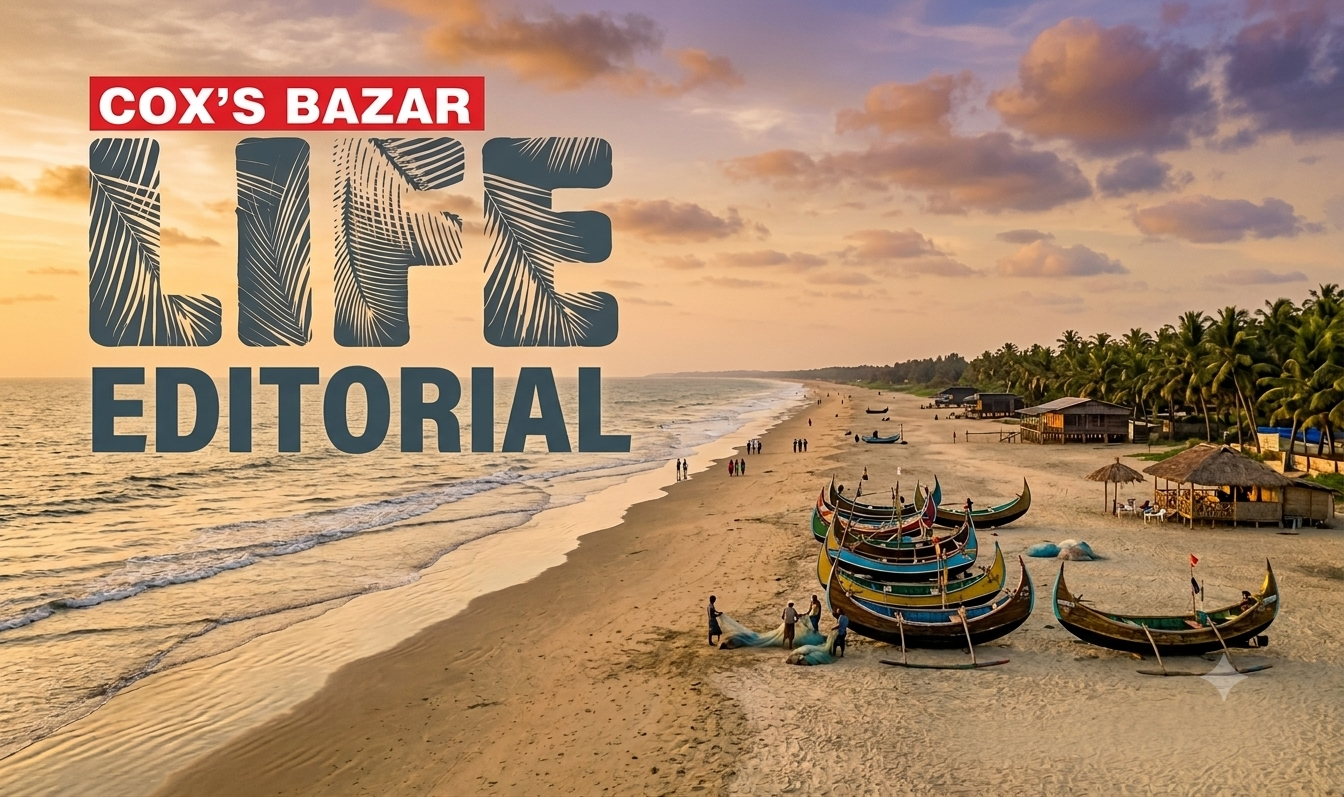
Cox’s Bazar is much more than a sea beach. It is one of Bangladesh’s most important tourism destinations and a major economic and cultural hub, where livelihoods, commerce and urban life converge. Any major infrastructure decision here, therefore, carries implications far beyond the construction of a road. It concerns the economy, the environment, urban planning and the future of the city.
The controversy over the proposed road from Sugandha Point to Simon Beach must be viewed in this wider context. The nearly 80-kilometre Cox’s Bazar–Teknaf Marine Drive has created important opportunities for tourism and connectivity, but its connection to the city remains a longstanding challenge. The narrow stretch between Kalatali and Bailey Hatchery, inadequate drainage and unplanned roadside development have contributed to persistent congestion and waterlogging. The present crisis is therefore also a consequence of years of shortcomings in urban planning and management.
Against this backdrop, a 1.28-kilometre road and town-protection embankment have been proposed from Sugandha Point to Simon Beach, with JICA involved in financing the project. Concerns over its potential impact on sand dunes and the coastal environment have, however, led to a court-ordered suspension of construction. The issue has now reached a point where development and environmental protection cannot be treated as competing priorities. What is needed is a sustainable balance between them.
Environmental concerns must be given due consideration. At the same time, greater attention should have been paid earlier to unplanned construction, encroachment on drainage channels and uncontrolled urban expansion, which have already placed considerable pressure on Cox’s Bazar. The present debate should therefore go beyond simply supporting or opposing the project and help establish a more responsible framework for future development.
Several questions require careful examination. Is the proposed alignment the most appropriate? Are there alternatives with a lower environmental footprint? What would be the long-term impact on sand dunes, coastal ecosystems and natural water flow? Can the city absorb the additional pressure that new infrastructure may create?
These questions require an independent, multidisciplinary assessment involving engineers, environmental experts and urban planners. Alternative alignments, elevated or low-impact road designs, effective drainage, dune protection and coastal risks should be evaluated within a common framework. The Marine Drive, airport, tourism zone and urban road network should also form part of a long-term integrated transport plan.
The court’s suspension should not be seen as an end to development, but as an opportunity to reassess the project. The government should proceed on the basis of scientific studies, expert assessments and public consultation, while civil society should contribute through constructive engagement and viable alternatives.
The objective should be neither development at the expense of the environment nor environmental protection at the expense of development. Cox’s Bazar’s future depends on bringing these priorities together through responsible planning, sound judgment and a clear vision for sustainable growth.
By Salam Abu
Editor