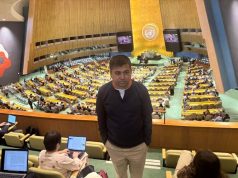


Dr. Rahman Nasir Uddin, a distinguished professor in the Department of Anthropology at the University of Chittagong, has joined Harvard University as a Visiting Scholar. As an affiliated scholar at Harvard’s South Asia Institute, he will conduct research in collaboration with the Harvard Law School, the Kennedy School of Government, the Harvard Asia Center, and the Department of Anthropology.
Dr. Rahman Nasir Uddin, a senior professor at the University of Chittagong, completed his undergraduate and postgraduate studies in Anthropology at the University of Dhaka. In 2008, he earned his PhD from Kyoto University, Japan, focusing on marginalizing culturally distinct people in postcolonial states. The following year, he pursued postdoctoral research as a British Academy Visiting Fellow, exploring the relationship between colonialism and postcolonialism in the UK. As part of this research, he worked at the libraries of the University of Cambridge, the University of Oxford, Durham University, the University of Hull, the University of London, and the University of Manchester.
Between 2010 and 2011, Dr. Rahman Nasir Uddin was a research fellow at the Delhi School of Economics, University of Delhi, conducting theoretical and archival studies on colonial legacies in postcolonial states. In 2012, he received the Humboldt Visiting Scholar fellowship in Germany, where he examined the history, development, and contemporary status of German and French social thought, along with critical and radical perspectives on the anthropology of the state. He also taught at a German university from 2012 to 2013.
In 2014, he became a Visiting Scholar at the London School of Economics (LSE), where he conducted advanced research on the intersection of Indigenous issues, state formation, and marginalization in postcolonial states. Since earning his PhD in 2008, he has completed four postdoctoral research programs. In 2018, he joined the Refugee Studies Centre at Oxford University as a Visiting Academic Scholar, where his research on the Rohingya refugee crisis gained international recognition. From 2018 to 2019, he also served as a Research Consultant at the School of Oriental and African Studies (SOAS), University of London.
In 2022, Dr. Rahman Nasir Uddin received a fellowship from the East-West Center in Washington, D.C., where he conducted research as an Asia Studies Fellow. During this time, he was also a Visiting Fellow at Johns Hopkins University. In 2023, he served as a Visiting Professor at the University of Sydney, Australia, followed by a tenure as a Distinguished Visiting Professor at Kyoto University, Japan. His extensive academic engagements across the globe have now led him to Harvard University, one of the world’s most prestigious institutions.
Dr. Rahman Nasir Uddin has been an invited speaker at numerous international seminars, symposiums, and workshops in countries including the United Kingdom, Canada, the United States, Japan, China, Malaysia, Indonesia, Thailand, India, Australia, Germany, the Netherlands, and France. His research papers and academic lectures have been widely recognized in global scholarly circles.
His research publications are included in the curricula of various universities worldwide. According to the international research index SCOPUS, two of his books, Deterritorialised Identity and Transborder Movements in South Asia (Springer, 2019), received global academic recognition in 2020. His 2020 book, The Rohingya: An Ethnography of ‘Subhuman’ Life (Oxford University Press), has gained significant acclaim in academic circles.
His theory of the “Subhuman”—introduced in The Rohingya: An Ethnography of ‘Subhuman’ Life—has been widely discussed in research on refugees, migration, displacement, and encampment.
Dr. Rahman Nasir Uddin hails from the historic Baharchhara village in Cox’s Bazar. He is the youngest son of the late Achiur Rahman (Mistri) and the late Ayesha Begum.
By Abdur Rashid Manik
Photo: Collected