
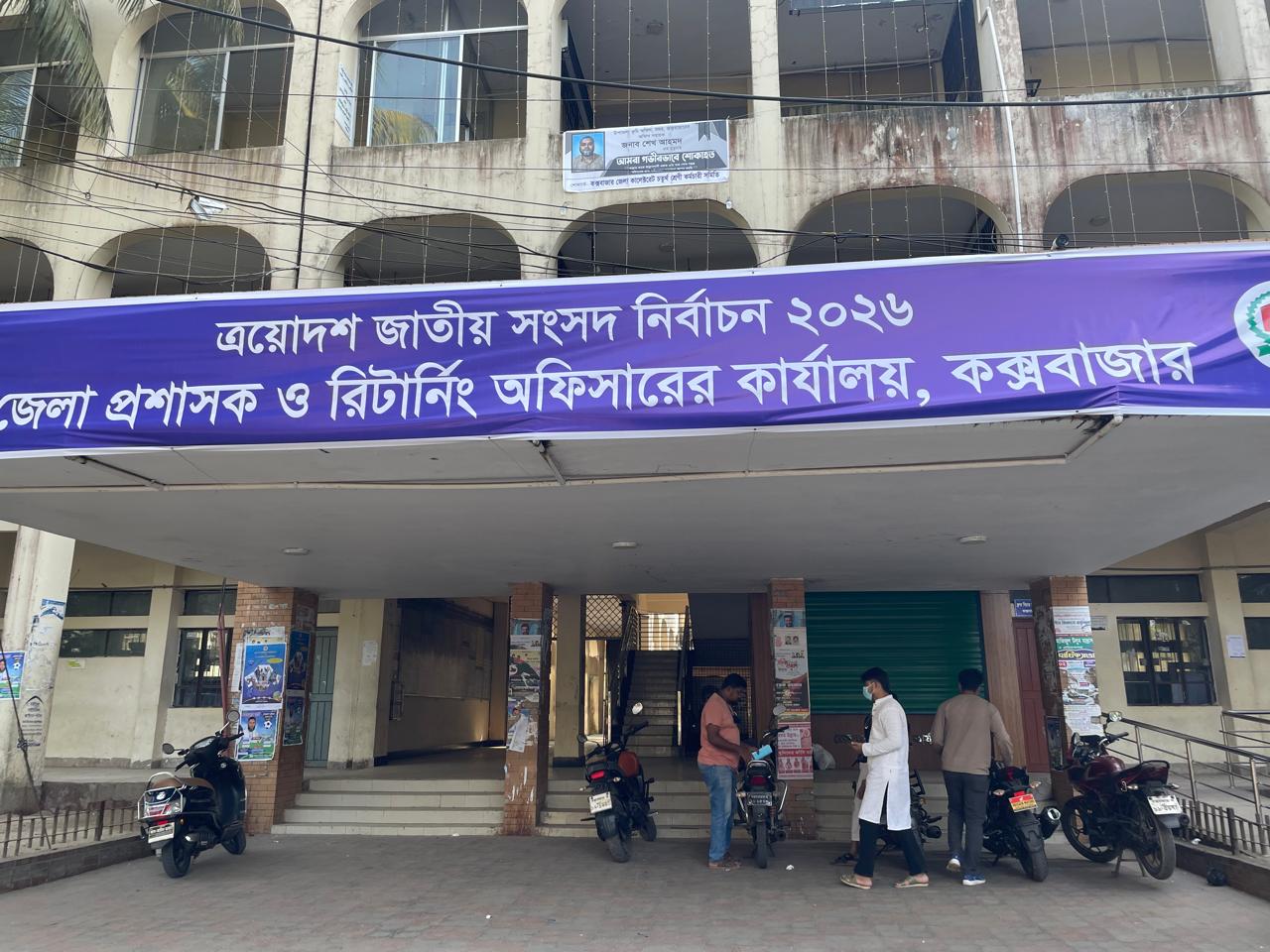
Ahead of the 13th National Parliamentary Election, the Returning Officer has formed a District Central Command Center in Cox’s Bazar to maintain law and order and coordinate election-related activities.
The command center will be responsible for closely monitoring the overall security situation, making immediate decisions, and coordinating with local law enforcement agencies during the election period.
Sources at the Returning Officer’s office said the command center, formed following a decision of the divisional core committee, has been operational at the Returning Officer’s office from 9 February to 14 February.
Senior officials from the Bangladesh Army, Border Guard Bangladesh (BGB), Navy, Bangladesh Coast Guard, RAB, Police, DGFI, NSI, Ansar, and Village Defence Force are assigned to the center.
The command center will conduct round-the-clock monitoring of the law and order situation before, during, and after polling, take swift decisions, and issue directives for the deployment of forces in the field when necessary.
The district administration stated that the command center will immediately address any untoward situation and issue direct instructions to bring it under control.
Given its geographical, social, and political realities, Cox’s Bazar has long been considered a sensitive district for election security. Border areas, coastal regions, localities adjacent to Rohingya camps, and past experiences of political violence have prompted heightened vigilance ahead of this election.
Law enforcement agencies have deployed additional personnel at vulnerable polling centers, intensified patrols, expanded search operations, and increased intelligence surveillance.
He further stated that they have deployed nine judicial magistrates, 34 executive magistrates, and sufficient law enforcement personnel for election duties.
According to the Returning Officer’s office, Cox’s Bazar district has a total of 598 polling centers across four parliamentary constituencies. Of these, 329 centers have been identified as “important” or high-risk, while the remaining 269 are considered general centers.
Constituency-wise, the number of high-risk polling centres is highest in Cox’s Bazar–3 (Sadar–Ramu–Eidgaon), where 109 of the 182 centres have been identified as high-risk. This is followed by Cox’s Bazar–1 (Chakaria–Pekua), with 93 out of 180 centres, Cox’s Bazar–4 (Ukhia–Teknaf), with 68 out of 117 centres, and Cox’s Bazar–2 (Maheshkhali–Kutubdia), where 59 of the 124 polling centres are considered high-risk.
These centers were identified as high-risk based on political rivalry, history of past clashes, high voter turnout, proximity to borders and Rohingya camps, and geographical considerations, officials said.
Local analysts believe that the effective operation of the District Central Command Center in a sensitive district like Cox’s Bazar will enhance voter confidence and significantly reduce the risk of election-related violence.
Additional Deputy Commissioner (Revenue) of Cox’s Bazar, Nizam Uddin Ahmed, said, “Ensuring a peaceful election is not just about the presence of forces; coordinated decision-making and rapid response are most crucial. That is why the command center’s operations have been strengthened.”
He added that nine judicial magistrates, 34 executive magistrates, and an adequate number of law enforcement personnel have been deployed for election duties.
With the 13th National Parliamentary Election scheduled for 12 February, all forces in Cox’s Bazar are now focused on ensuring security, maintaining effective coordination, and providing voters with a safe and uninterrupted environment to exercise their voting rights.
By Abdu Rashid Manik
Photo: Abdu Rashid Manik