
A tangy, herb-rich fruit locally known as Horgula is becoming increasingly popular across Cox’s Bazar and the Chittagong Hill Tracts. Commonly referred to as the Horgula plant or Hor pata by locals, the fruit is known as Amilye among hill communities and Pu Si in the Marma language.
In other parts of Bangladesh, it is called Chukai, Mesta, or Chukur. Internationally, the fruit is known as Roselle, Rozel, or Sorell, with the scientific name Hibiscus sabdariffa.
In rural areas of Cox’s Bazar, the sour fruit plant is a familiar sight in household courtyards.
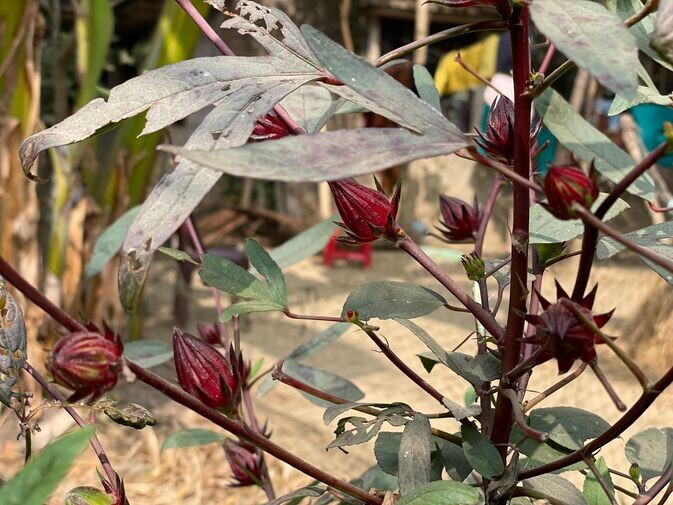
The short, bushy plant bears yellow flowers marked with deep maroon centers, while its reddish-green leaves and bright red fruit add to its visual appeal.
The fruit, surrounded by eight to ten wing-like ridges that are not sharp, is prized for its distinctly tangy flavor.
Demand for the plant is steadily rising, as its leaves, fibers, and fruit are all widely used.
In Cox’s Bazar, people commonly consume Hor pata as a vegetable, while in the hill tracts, indigenous communities dry the fruit in the sun and use it in chutneys, curries, and even as a sour tea ingredient.
During the harvest season, hills covered with jhum cultivation appear dotted with clusters of vibrant red fruit, lending the slopes a striking hue.
Rich in vitamin B6 and vitamin C, the fruit is believed to possess various medicinal benefits.
Locals say it helps relieve mouth sores, constipation, urinary discomfort, and certain skin conditions.
Its sour taste also makes it suitable for producing jam, sauce, jelly, and pickles.
Roselle tea has recently gained popularity across the country, with particularly high demand in the three hill districts of the Chittagong Hill Tracts.
Many buyers are now purchasing the fruit in bulk, often carrying it away in large bags.
Originally native to Africa—most likely West Africa—Hibiscus sabdariffa spread to Asia and the West Indies in the early 16th and 17th centuries.
Today, it grows naturally in many regions. The plant’s stems are used to produce bast fiber, while its dried calyces are used to make a cranberry-like beverage known internationally as zobo or karkade.
With its deep roots in local culture, cuisine, and traditional medicine, this tangy fruit—roselle—has become more than just a seasonal delicacy.
For the people of Cox’s Bazar and the Chittagong Hill Tracts, it is increasingly becoming a part of everyday life.
By Abdu Rashid Manik
Photo: Abdu Rashid Manik