
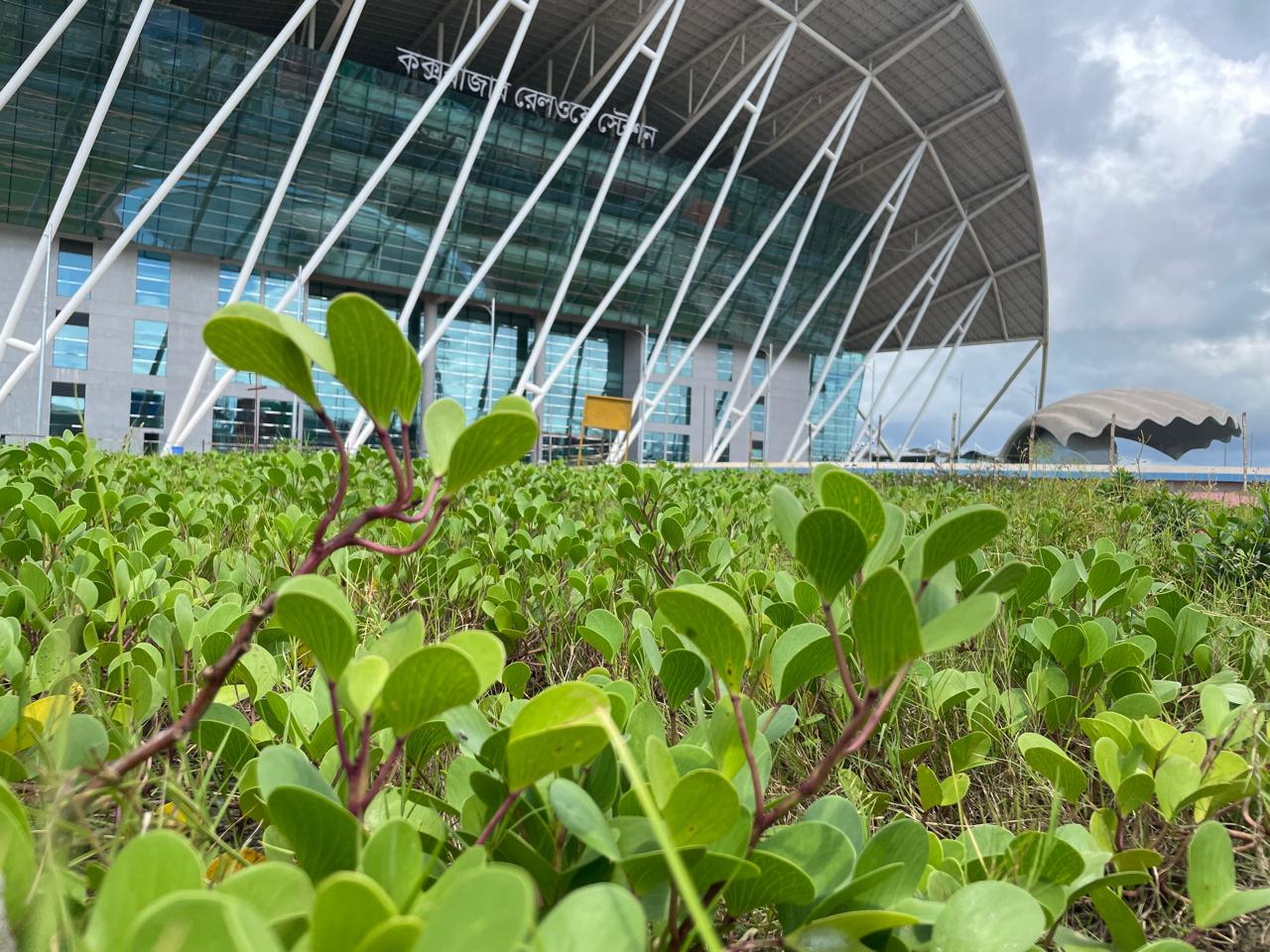
The Railroad Vine, known locally as “Sagarlata” and scientifically as Ipomoea pes-caprae, is a striking plant often found sprawling across the sandy beaches of Cox’s Bazar. With its lush green vines and delicate pink blooms, it mirrors the elegance of railway tracks, earning its English name. Recently, this coastal treasure has found a new home—not on the beach, but at Cox’s Bazar’s iconic rail station, an architectural marvel shaped like a seashell.
Surrounded by vibrant stretches of Railroad Vine, the rail station feels like a piece of the seaside itself. Locals fondly refer to this plant as “Daunga”, a term embedded in the cultural lexicon of Cox’s Bazar.
Station Master Golam Rabbani said that the design of the station was intentionally inspired by the coastal environment to evoke the feel of the beach as soon as travelers arrive.
“The seashell-inspired structure surrounded by Sagar Lota gives a sense of the sea’s beauty right at the station,” he added.
However, maintaining this natural adornment hasn’t been without challenges.
“Thousands of visitors damaged the vines initially, but we’ve fenced the area to protect them,” he added.
By Abdur Rashid Manik
Photo: Abdur Rashid Manik