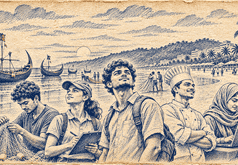
The nearly 250-year history of Cox’s Bazar’s traditional handicrafts remains as alive as the roar of the sea. Rakhine weaving, intricate seashell ornaments and bamboo and cane products embody the region’s distinctive folk heritage. Shaped by the sea and its silver sands, these crafts reflect not merely artistic beauty but the cultural memory of generations. Handmade traditions preserve skills and identities passed down through families.
Yet this heritage faces a deep economic crisis. Cheap plastic alternatives, rising raw material costs and competition from machine-made products are steadily eroding its market. Artisans who have sustained these traditions for generations struggle to secure fair prices, often losing income to middlemen. Without institutional support or affordable credit, younger people increasingly seek other livelihoods. Irreplaceable knowledge risks disappearing with them.
Tourism destinations such as Bali and Phuket have made local crafts an integral part of the visitor experience. Despite welcoming millions of visitors, Cox’s Bazar has yet to create comparable opportunities for its artisans. Rakhine women weavers, in particular, face expensive materials, low-cost competition and limited access to buyers.
Tourism businesses estimate that Cox’s Bazar receives six to eight million visitors annually. If 7.5 million visitors each spent an average of Tk 300 on locally made crafts, the potential market would reach Tk 225 crore a year. This is a hypothetical calculation, not recorded sales, and its assumptions require verification through market research. Purchases by hotels and resorts, online sales and exports could expand the opportunity further. Reliable surveys are needed to assess employment, export earnings and tax revenue.
A coordinated public-private response is essential. Immediate priorities should include registering artisans, ensuring fair prices and providing affordable long-term loans. Over the medium term, training centres and design laboratories could improve quality, innovation and competitiveness. Cooperative purchasing could ease raw material shortages, while appropriate tariff relief deserves consideration. Seashells and other marine materials must be sourced legally and sustainably, without harming coastal biodiversity.
Hotels, resorts and tourism operators should purchase local crafts for interiors, gifts and retail outlets. Permanent beachfront cultural markets, producer cooperatives, dedicated e-commerce platforms and access to international tourism fairs would connect artisans directly with customers, allowing them to retain more earnings. In the longer term, suitable traditional products could be assessed for Geographical Indication (GI) status, strengthening their distinct identity.
Preserving these crafts is not simply about protecting heritage; it is about sustaining livelihoods, empowering women and ensuring that the prosperity of tourism reaches the communities that keep this heritage alive. With thoughtful investment and direct market access, Cox’s Bazar’s handicrafts can become a stronger pillar of its tourism economy.
By Salam Abu
Editor