
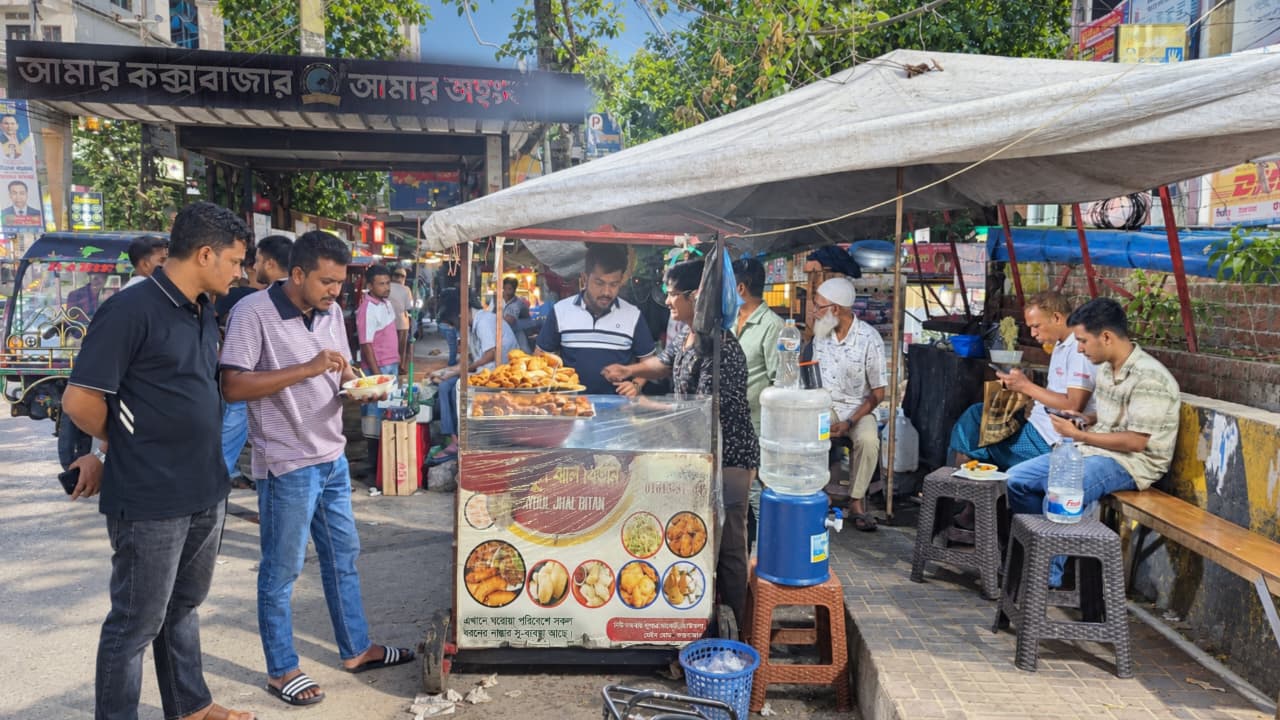
Food stalls on footpaths and beside roads in Cox’s Bazar city will also fall under the Bangladesh Food Safety Authority (BFSA) ‘s registration and licensing requirements, which plans to make registration or licensing mandatory for food businesses from November 1.
The requirements will apply, as appropriate, to temporary and mobile street food stalls, restaurants, bakeries, food manufacturers and importers.
However, questions remain about how well street food vendors in Cox’s Bazar understand the new rules.
Small traders sell tea, snacks, fuchka, chotpoti, jhalmuri, fried items and other food from footpaths and roadsides across the city. Many operate temporary stalls. Vendors still have limited awareness of how to register, when a licence is required, and what documents they need to submit.
A visit to Sugandha Point and other areas of the hotel-motel zone found numerous food stalls operating along roads and footpaths.
When asked about the mandatory registration and licensing requirements, hotel trader Hafez Mia said he had not heard of the new rules and did not know how to register.
Hasan Ullah, another food vendor in the same area, said, “Nobody has told us where to apply for registration, what documents we need or whether we have to pay any fee. We are not aware of these matters either.”
Mohammad Selim, who sells food from a temporary roadside stall, said he would register if the government introduced such a requirement.
“If they explain the process to us, we will try to register if it is within our means,” he said.
The BFSA published the Safe Food (Registration and Licensing) Regulations, 2026, in the official gazette on July 16. Following the publication, the authority called on relevant food businesses and establishments to apply for the required registration or licences within the stipulated period.
The authority said first-time registration would be free for 16 categories of food businesses. However, specialised food products would require licences, for which applicable fees would have to be paid. Registration and licences would remain valid for three years.
BFSA registration numbers must also be displayed on food product packaging. Operating a food business without the required registration or licence is a punishable offence.
Initially, applications may be submitted to the relevant district offices. The authority plans to introduce a fully online application system in phases.
Concerned citizens emphasise the need to raise awareness among street food vendors in Cox’s Bazar, explaining the registration process to them in simple terms.
Abu Morshed Chowdhury Khoka, president of Cox’s Bazar Civil Society, said providing vendors with proper guidance and bringing them under regular monitoring were as important as registration.
“Vendors must be made aware of hygiene and cleanliness during food preparation and serving, in addition to ensuring the supply of quality and safe food. Above all, they should receive training on hygiene, food quality and appropriate behaviour towards customers,” he said.
Many street food vendors lack sufficient knowledge of these matters, he said, adding that the relevant authorities should raise awareness, explain the rules, and encourage compliance.
Subrata Bhattacharya, a food safety officer at the BFSA’s Cox’s Bazar district office, said initiatives were underway to inform vendors about which categories apply to temporary and mobile food stalls, how to obtain registration or licences, what documents are required, and where to submit applications.
“Leaflets have already been printed, and we have decided to conduct public announcements and monitoring. Field-level activities will begin on November 1. We hope to implement the initiative after completing this 15–20-day campaign,” he said.
By Tarekur Rahman