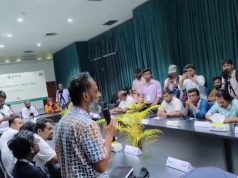

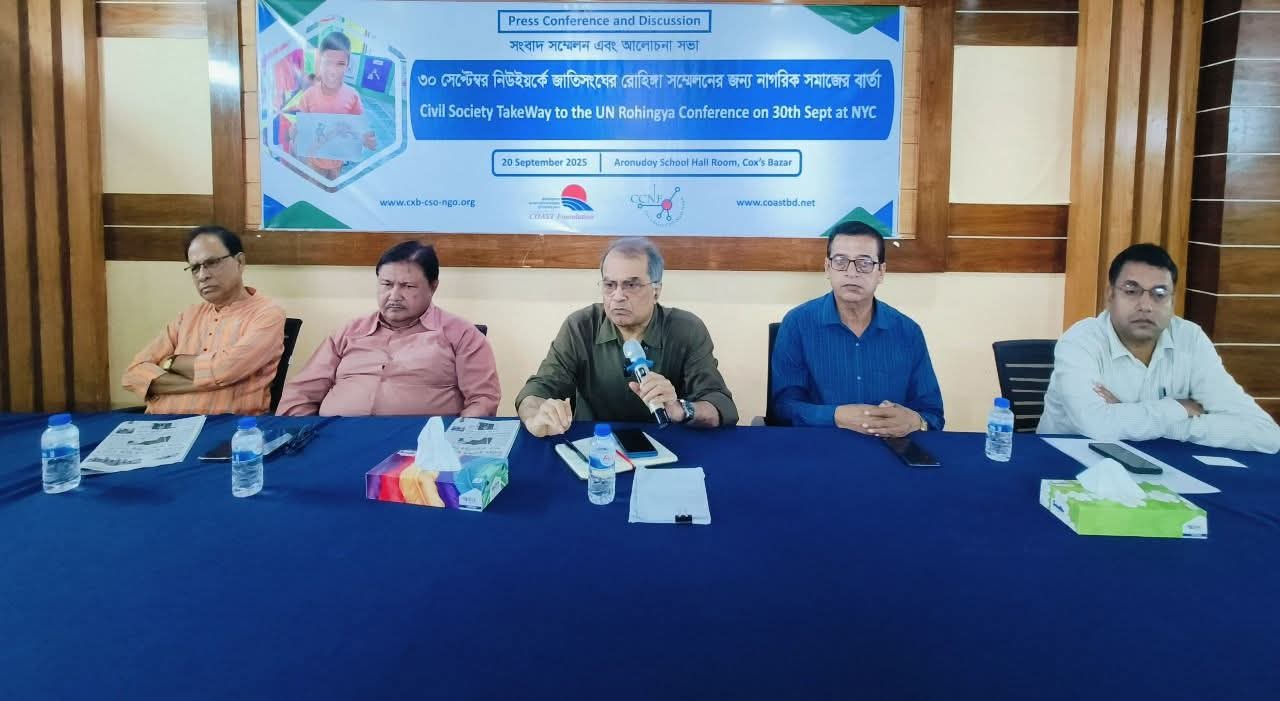
Ahead of the upcoming UN Rohingya Conference on September 30, speakers at a roundtable discussion and press briefing in Cox’s Bazar called for urgent investment by the United Nations and the international community in safe drinking water solutions, farmland restoration, and effective waste management.
COAST Foundation organized the event at the Arunoday School auditorium, with Executive Director M. Rezaul Karim Chowdhury presiding and Assistant Director Jahangir Alam moderating.
The program opened with a documentary produced by the COAST Foundation, which showcased the impact of Rohingya settlement on groundwater depletion, loss of farmland, and rising waste generation.
The film revealed that 20–25 million liters of groundwater are extracted daily in Ukhiya and Teknaf, causing the water table to drop by 4–12 meters yearly. In Teknaf, 65 percent of groundwater sources are now saline.
Where water was once available at 80–90 feet, clean water cannot be found even at depths of 1,000 feet.
The documentary also highlighted that Rohingya camps generate around 10,000 tons of waste per month, while Cox’s Bazar municipality produces 90–130 tons per day, 30–50 percent of which comes from tourism.
Speakers stated that unmanaged waste in the Ukhiya-Teknaf area has resulted in the loss of nearly 300 acres of farmland.
Restoring those lands could yield approximately 30,000 tons of crops annually.
Among those present were Cox’s Bazar Press Club President Mahbubur Rahman, former Ukhiya College Principal Ajit Das, former APP Saki A Kawsar, writer Ruhul Kader Babul, Save the Cox’s Bazar President Touhid Belal, Adhikar Cox’s Bazar President Advocate Abu Musa Mohammad, former Palongkhali UP Panel Chairman Muzafor Ahmed, Help Cox’s Bazar Executive Director Abul Kashem, and members of the press.
Proposed solutions included waste segregation for composting and recycling, fertilizer production from human waste, rainwater harvesting, re-excavation of abandoned ponds, limited groundwater use, and desalination of the Naf River or seawater for camp supply.
Rezaul Karim Chowdhury stressed that “waste must be turned into energy” and called for scientific waste management in Cox’s Bazar to convert biodegradable waste into compost and recycle non-biodegradable materials for economic value.
Mahbubur Rahman stressed the importance of installing alternative drinking water sources, permanent waste treatment facilities, and restoring abandoned farmland for cultivation.
Ajit Das noted that locals near the camps have lost vast portions of farmland and urged donors to fund efforts to reclaim and return these lands, as Rohingya repatriation is not likely soon.
Abul Kashem and Muzafor Ahmed echoed calls to restore cultivable land and secure water sources. Ahmed noted that Palongkhali now faces severe water shortages despite drilling as deep as 700 feet.
Erfan Hossain said converting plastic waste into diesel or recyclable products was possible and urged UN agencies to take responsibility for long-term solutions to protect the environment.
Saki A. Kawsar concluded by stressing the importance of waste management for the host community and the need for treated Naf River water to be supplied to the Rohingya camps nationally and internationally.
By Abdu Rashid Manik
Photo: Courtesy