
Interim government Chief Adviser Dr Muhammad Yunus has urged the international community to show goodwill in creating a “realistic roadmap” for a sustainable solution to the Rohingya crisis.
He stressed that adequate measures must be taken immediately to ensure that Rohingya refugees can return to their homeland with dignity and security.
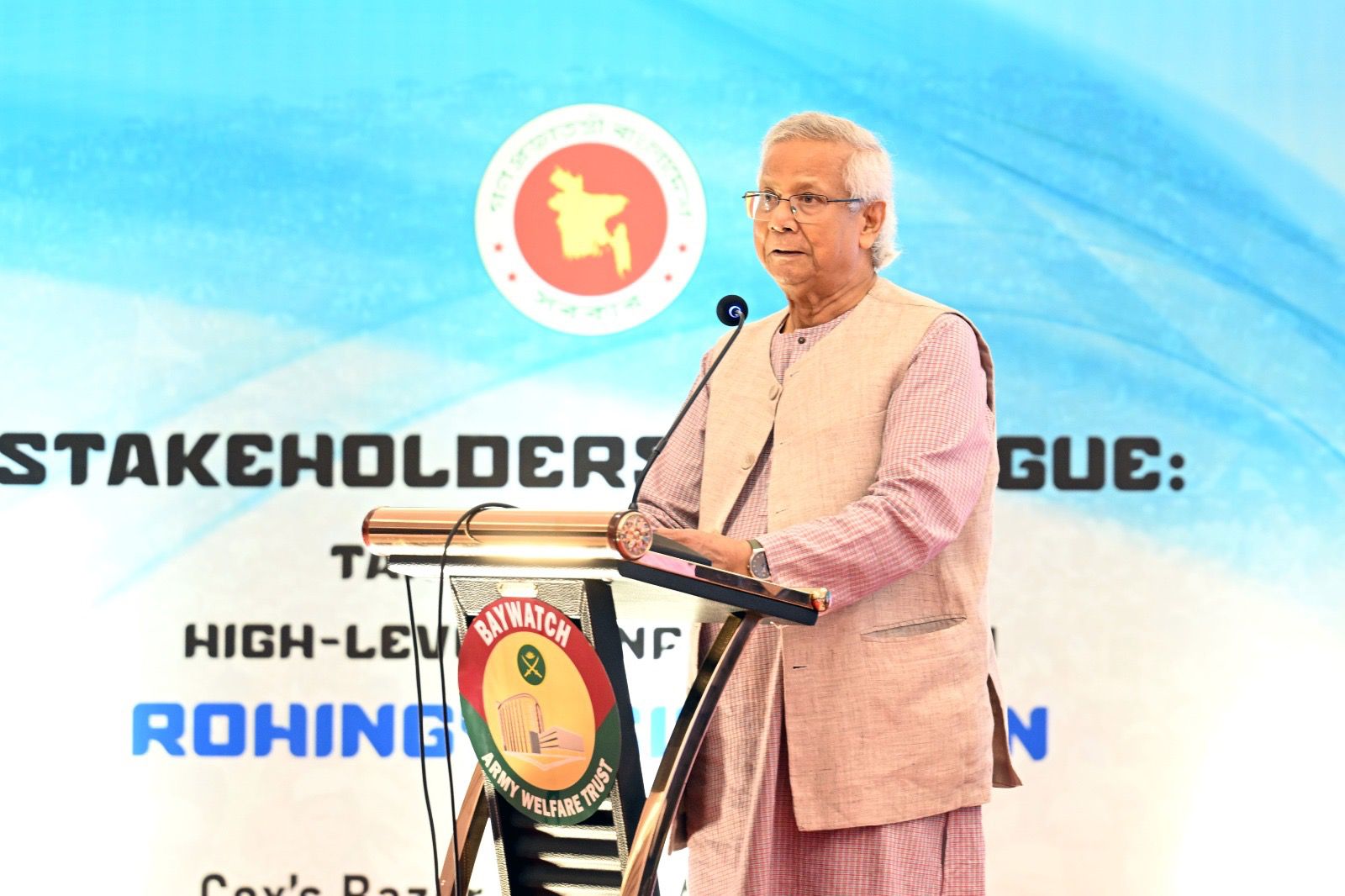
Speaking as the chief guest at the opening session on the second day of the international conference titled “Stakeholders’ Dialogue on the Rohingya Situation” in Cox’s Bazar on Monday (August 25) morning, Dr Yunus called on world leaders to act without delay.
“On this day in 2017, nearly 800,000 Rohingyas crossed the border into Bangladesh to save their lives. Sadly, even today, we continue to witness new arrivals. On such a day, it is our moral responsibility to stand on the right side of history and prevent armed groups from carrying out ethnic cleansing,” he said.
He cautioned, “It would be a grave mistake if we wait until the last trace of the Rakhine community disappears. We cannot allow that to happen. The international community has pledged to repatriate the Rohingyas. When the UN Secretary-General visited here last March, he fasted alongside them and shared iftar with around 150,000 Rohingyas, giving them hope that the world stands by them and will help them return home to celebrate festivals like Eid with their families in Myanmar.”
Dr Yunus noted that fear is still visible in the eyes of Rohingya men and women when they recount the unspeakable atrocities they endured. “Bangladesh opened its borders on humanitarian grounds in 2017 and earlier. We cannot remain silent in such a situation. Greater international engagement is needed now more than ever.”
Praising humanitarian agencies, donors, and partners for their continued support, he stressed that their efforts must continue until repatriation is achieved.
Currently, Bangladesh is hosting about 1.3 million Rohingyas, making Cox’s Bazar the world’s largest refugee camp. Around 22,000 children are born in the camps every year, while fewer than half a million Rohingyas remain inside Myanmar, he said.
“This proves that ongoing persecution is forcing them out. Over the past eight years, the people of Bangladesh, particularly in Cox’s Bazar, have made tremendous sacrifices. Our economy, resources, environment, society, and governance are under immense strain,” he added.
Despite the challenges, Dr Yunus said Bangladesh remains committed to keeping the Rohingya issue high on the global agenda until a sustainable solution is found. “This dialogue is amplifying Rohingya voices and helping shape a roadmap for swift, safe, and sustainable repatriation. But this is not Bangladesh’s responsibility alone—the international community must step up.”
Marking eight years since the mass exodus, the Chief Adviser proposed a seven-point action plan to resolve the crisis:
- Safe, Voluntary Repatriation: Rohingyas must be able to return home safely, voluntarily, and sustainably. A practical roadmap should be drawn up without further delay.
- Sustained International Support: Humanitarian efforts must continue. Donors should honor commitments and ensure adequate, sustainable funding for the future.
- End Persecution Immediately: Myanmar authorities and the Arakan Army must guarantee the safety, security, and livelihoods of Rohingyas, and ensure that no more are forced to flee. Displaced Rohingyas inside Myanmar must be allowed to return to their homes swiftly.
- Dialogue and Rights Assurance: A platform must be created to end violence and ethnic persecution within Myanmar. Constructive dialogue between the government, Rakhine authorities, and Rohingyas is essential to ensure rights and voluntary repatriation.
- The role of the international community, especially ASEAN, must be an active one in creating a safe environment in Rakhine State. Collective global cooperation can bring this crisis to an end.
- Opposition to Ethnic Cleansing: Regional and international actors must take a firm stand against ethnic cleansing.
- Justice and Accountability: The global community must ensure justice, accountability, and decisive steps to end genocide and crimes against humanity. “The time for justice is now,” he emphasized.
Dr Yunus expressed hope that the outcomes of the Cox’s Bazar dialogue would carry significance at the upcoming high-level conference on the Rohingya crisis, scheduled for September 30 at the UN Headquarters in New York.
On elections, he said Bangladesh is now stable and ready for polls. “The election schedule will be announced in early February,” he confirmed.
National Security Adviser and High Representative on Rohingya Issues Dr Khalilur Rahman, along with Disaster Management and Relief Adviser Faruk-e-Azam, also spoke at the session.
Diplomats, international experts, academics, political leaders, representatives of global organizations, and members of the Rohingya community were present.
Earlier in the morning, the Chief Adviser landed at Cox’s Bazar airport at 10 am and reached the conference venue at Hotel Bay-Watch in Inani by road around 11 am.
The three-day conference, jointly organized by the Ministry of Foreign Affairs and the Office of the High Representative on Rohingya Issues, began on Sunday (August 24). On the closing day, August 26, participants are scheduled to visit the Rohingya camps.
By Abdu Rashid Manik and Mohammad Morshed
Photo: CA Press Wing