
As Baishakh enters the second week, there has been no sign of rainfall. Continuous sunshine and intense heat have created a severe crisis for betel nut and coconut plantations in the hilly areas of Cox’s Bazar.
Newly planted saplings are particularly at risk of drying out.
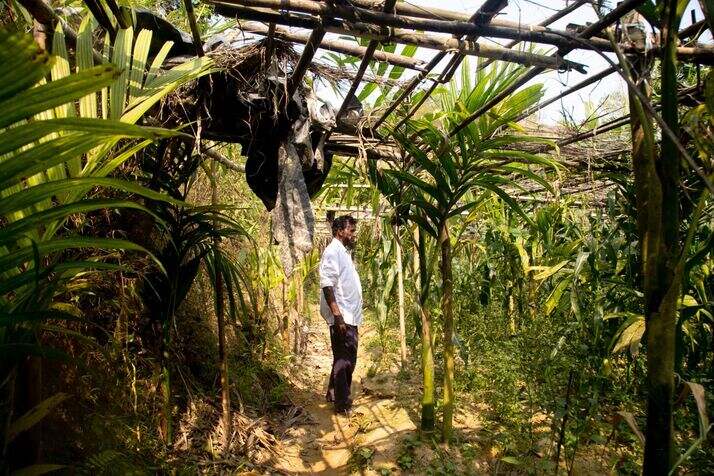
In response, farmer Kabir Ahmed from Goalia village has taken an innovative approach.
He is protecting betel nut and coconut saplings by keeping them inside betel leaf enclosures, shielding them from direct sunlight.
Kabir Ahmed said that the prolonged dry spell has left the soil in hilly areas parched. Due to the lack of water, saplings of betel nut, coconut, and other fruit and flowering plants are drying up rapidly.
He cautioned that a delay in rainfall could lead to further damage to numerous plantations in the hills.
He explained that the shaded environment inside betel leaf enclosures remains relatively cooler, allowing him to temporarily protect the saplings from extreme heat.
Expressing his passion for agriculture, Kabir Ahmed said he has developed betel nut and coconut gardens on ancestral land.
He also cultivates mango, black plum, and jackfruit in hilly areas, along with paddy in agricultural fields, where yields have been excellent this season. In addition, he grows various seasonal vegetables.
Meanwhile, Md. Abdul Hannan, assistant meteorologist at the Bangladesh Meteorological Department in Cox’s Bazar, said such heat is typical during Boishakh, but higher humidity levels are making it feel more intense.
He noted that temperatures may remain similar over the coming days, with occasional gusty winds.
Over the past week, temperatures in Cox’s Bazar have fluctuated between 33°C and 34.5°C, while humidity levels have ranged between 60 and 65 percent, increasing discomfort in daily life.
By Mohammad Morshed
Photo: Hussain Shetu