
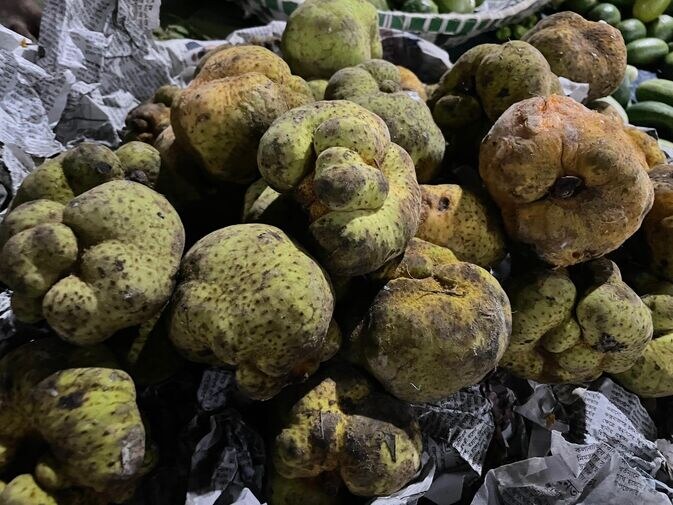
Once a familiar fruit across rural Bangladesh, the native fruit locally known as batta has now become a rarity in Cox’s Bazar. Many among the younger generation have never heard of it, let alone tasted it. However, Court Building Market in Cox’s Bazar town recently offered the increasingly uncommon fruit for sale.
Mohammad Siraj, a fruit vendor selling batta near the Model Mosque adjacent to the market, said he had collected the fruits from the Chakdhala area of Ramu Upazila.
According to Siraj, many young people today are unfamiliar with the fruit and know little about its taste, nutritional value, or traditional significance. Elderly people, however, still seek it out and buy it with enthusiasm.
‘Many customers ask about the fruit because they do not recognise it. Older people identify it immediately and often tell us they used to eat it as children. “Nowadays, the tree itself is rarely seen,” he said.
He added that each fruit is being sold for Tk 30-40. Due to its rarity, the fruit has attracted considerable curiosity among shoppers.
Known locally by various names, including dewa, dhewa, madar, dewaphal, dhewaphal, bon kathal and batta, the fruit has a distinctive sweet-and-sour taste. Its Sanskrit name is Lakucha, while it is known in Hindi as Dehua.
The scientific name of the tree is Artocarpus lacucha (also known as Artocarpus lakoocha Roxb.), a tropical evergreen species in the family Moraceae.
Experts say the tree grows naturally across the Indian subcontinent and parts of Southeast Asia. In addition to producing edible, nutritious fruit, the tree is valued for its high-quality timber, which is used for a variety of purposes.
The fruit contains several vitamins and minerals that benefit human health, making it both a nutritious and culturally significant native species.
Local elderly residents recalled that batta trees were once commonly found in villages across Cox’s Bazar. However, rapid urbanisation, shrinking forest areas and a declining interest in preserving indigenous fruit trees have pushed the species towards local extinction.
They stressed the need for initiatives to conserve and replant native fruit trees such as batta to protect the country’s biodiversity and agricultural heritage.
Without such efforts, they warned, future generations may know the fruit only through books and historical records.
By Abdu Rashid Manik
Photo: Abdu Rashid Manik