
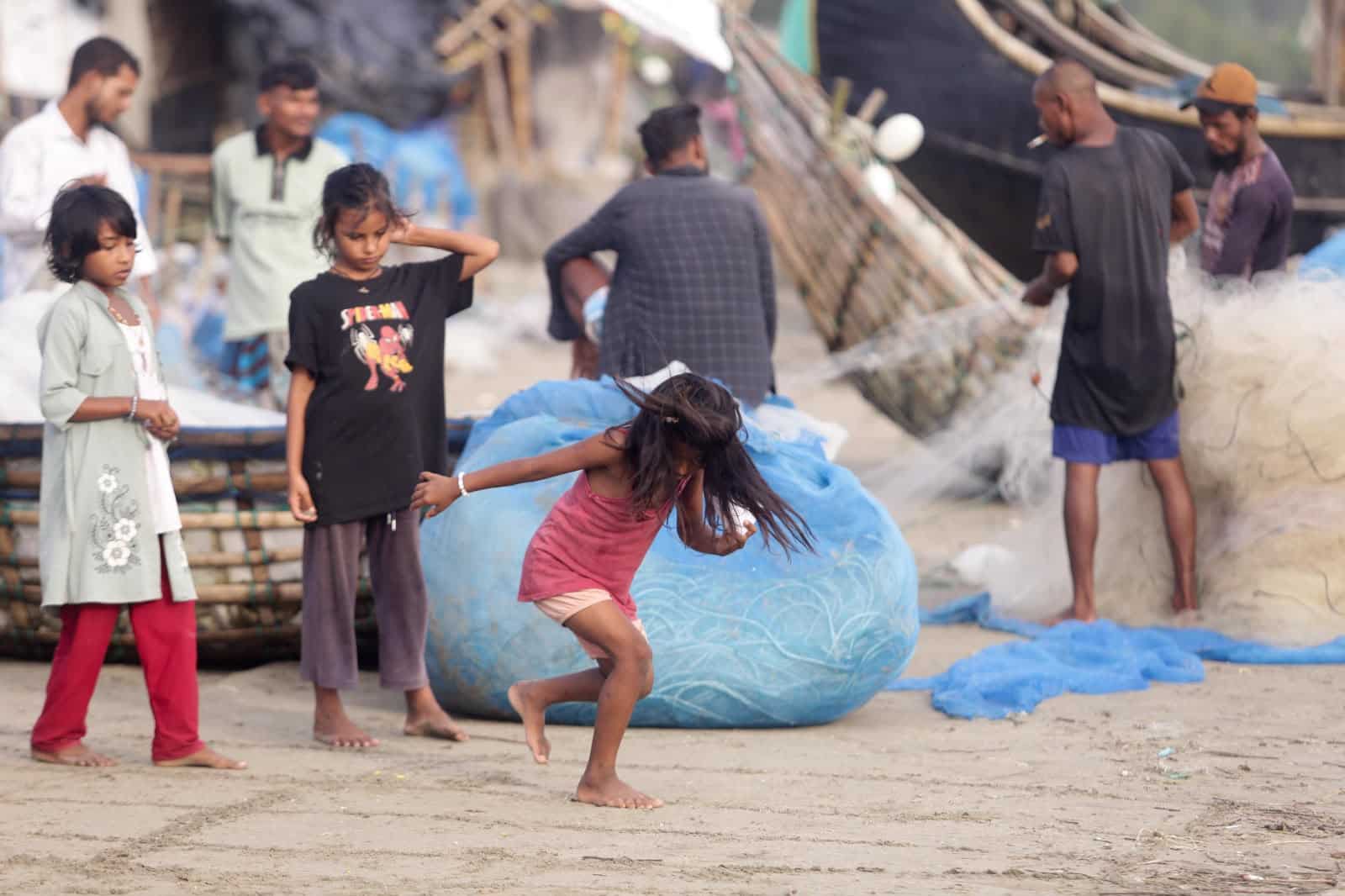
The traditional Bangla game of ekkadokka (hopscotch) continues to thrive in the Darianagar fishing village of Cox’s Bazar, where teenage girls gather every afternoon to enjoy the centuries-old pastime despite the growing popularity of smartphones and digital games.
A recent visit to the village found girls playing the game in an open space in front of their homes. Squares had been drawn on the ground, and the players took turns tossing a small stone or broken tile into the marked boxes before hopping through them according to the rules.
The girls’ competition filled the area with laughter and excitement.
Under the rules of the game, a player is eliminated if the marker lands outside the designated square or on a boundary line, if a foot touches a line while hopping, or if the marker strikes a line while being pushed through the course. The next player then takes a turn, and the winner is the one who successfully completes all the squares.
Local resident Hafiz Alam, in his sixties, recalled that ekkadokka, gollachut and kanamachi were once common afternoon games for children.
‘In our childhood, boys and girls used to spend their afternoons playing these traditional games. Now, mobile phones have pushed many of them into decline. It is heartening to see that some children in this fishing village are still keeping the tradition alive. Watching them play brings back memories of my childhood,’ he said.
Residents said indigenous games such as ekkadokka are more than a source of entertainment. They help children develop physical fitness, balance, concentration and social interaction.
At a time when digital entertainment dominates children’s leisure, the sight of girls playing ekkadokka in Darianagar fishing village offers a vivid reminder of a fading rural tradition and the simple joys of childhood.
By Mohammad Morshed
Photo: Hussain Shetu