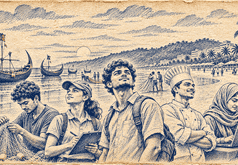
Long before dawn breaks over Cox’s Bazar, fishing boats set out into the Bay of Bengal carrying more than nets and hopes of a good catch. They carry generations of memories, beliefs and stories of survival. The roar of waves, the rhythm of oars, the fear of storms and the longing for home echo through the coast’s songs and folklore. Far from mere entertainment, these are living records of people whose lives, work and imagination are inseparable from the sea.
Songs, stories and rituals have long shaped the identity of Cox’s Bazar’s fishing communities. Alongside Bangladesh’s Bhatiyali, Sari and Baramasi traditions, local fishermen possess an oral heritage that deserves closer study. A 2018 ethnographic study in Marine Policy explored the close relationship between the sea, beliefs and everyday life among Maheshkhali’s fishing communities.
The region’s wider folk music also reveals how easily cultural contributions go unrecognised. Abdul Rashid Master, a fisherman from St Martin’s Island, created the popular song Madhu Hoi Hoi Bish Khawaila, yet his authorship remained obscure for years. Folk musician Amanullah Gayen composed hundreds of songs, but one gained renewed attention only after his death. Singer Bulbul Akter’s struggles likewise show that popularity rarely guarantees financial security.
Changing tastes, generational divides and weak institutional support threaten these traditions. Nobody knows how many songs have vanished. Many more survive only in the memories of ageing performers, making recording them a race against time.
There are lessons abroad. UNESCO has recognised Pantun, an oral poetry tradition associated with Malaysia and Indonesia, and Belgium’s coastal practice of shrimp fishing on horseback. Both demonstrate that community knowledge and everyday customs deserve cultural recognition.
Cox’s Bazar needs a coordinated effort involving universities, cultural organisations, authorities and fishing communities. A digital archive should record songs, creators, dialects, melodies and performance histories. Preservation must also protect artists’ rights, acknowledge original creators and ensure fair payment rather than treating performers as decorative attractions.
This work could enrich the blue economy. A pilot Coastal Folk Heritage Programme in St Martin’s, Maheshkhali and Cox’s Bazar could identify performers, document their music and arrange regular performances at hotels and resorts. Music publishing and cultural tourism could create livelihoods without adding pressure to fragile coastal environments, provided communities receive a fair share of the benefits and retain control over how their traditions are presented.
The blue economy cannot be measured solely in fish, ports and marine resources. It must also recognise the cultural inheritance of coastal people. The sea sustains their livelihoods; its songs sustain their identity. Losing those songs would mean losing not merely melodies, but an irreplaceable chapter of the coast’s living history.
By Salam Abu
Editor