
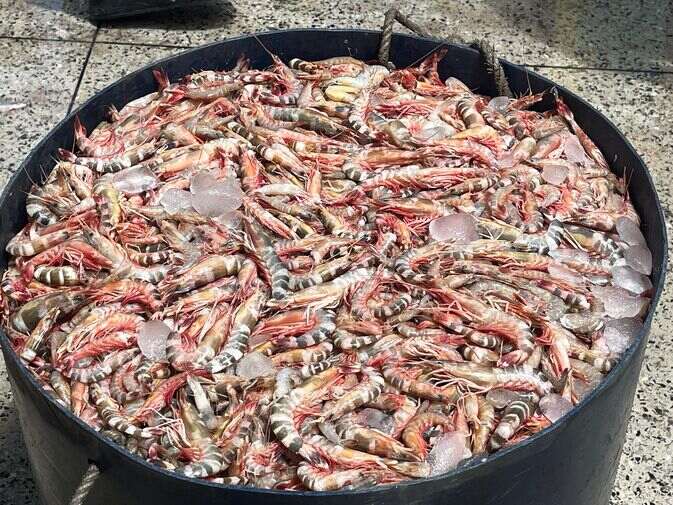
At Cox’s Bazar Fishery Ghat, drums filled with bright red shrimp are now a common sight. This species of marine shrimp, known for its striking red color, is regularly caught in the nets of local fishermen along the coast.
Not long ago, fishermen would discard these shrimp on the beach, where crows fed on them. Locally, they were nicknamed “Kaua Icha” (crow’s shrimp).
But in recent years, the same shrimp has found a new identity. Vendors along the beach began coating them in flour and frying them for tourists, giving rise to the popular snack known as “Cap Tiger.”
Over the past year, the species has taken on even greater economic value. Rebranded as “Red Tiger Shrimp,” it is now being exported to several European countries.
Within Bangladesh, it has also made its way into high-end restaurants and star-rated hotels in Cox’s Bazar, Chattogram, and Dhaka, where it is often served in soups. Locals, however, continue to call it “Lal Icha” and sometimes cook it in traditional curries.
In local markets, prices reflect its growing popularity. While black tiger shrimp (Bagda Icha) sells for Tk 700–900 per kilogram and smaller white shrimp for Tk 400–500, red tiger shrimp is relatively affordable at Tk 150–200 per kilogram.
Once considered worthless, this “crow’s catch” is now not only a delicacy but also an emerging player in Bangladesh’s blue economy, contributing to both local livelihoods and foreign exchange earnings.
By Mohammad Morshed
Photo: Mohammad Morshed